
Kyle Weiger
Share This
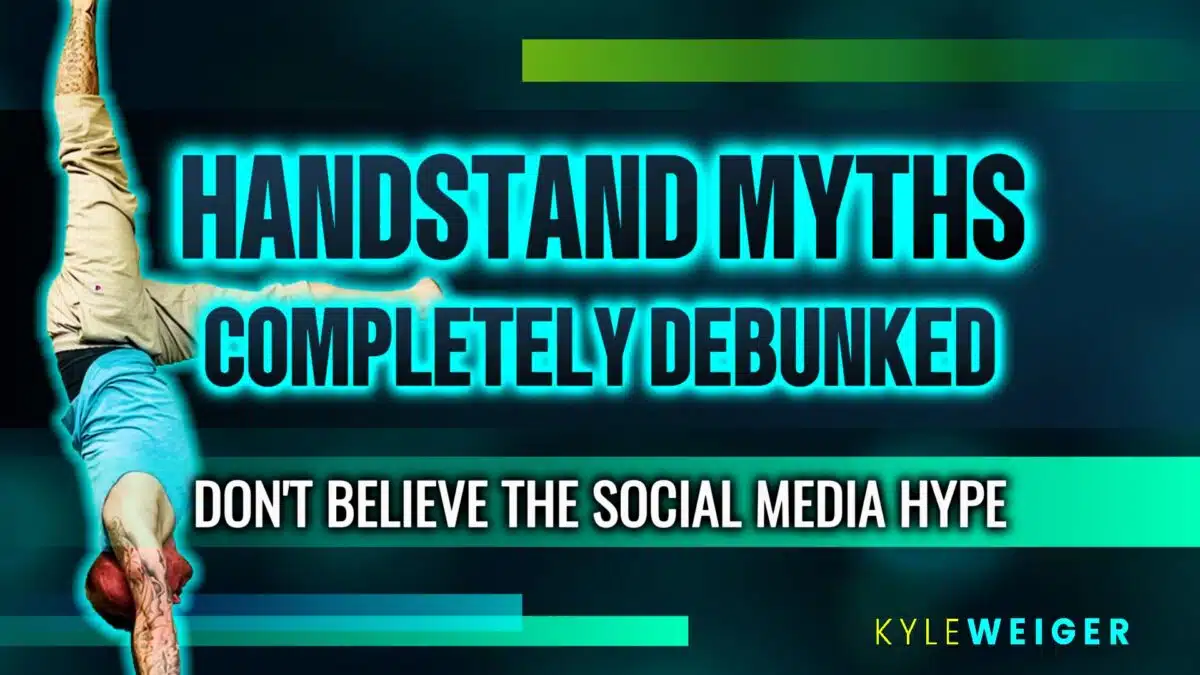
The 5 Biggest Handstand Myths (And Why They’re Keeping You Stuck)
The internet is filled with handstand myths that sound convincing but are completely wrong.
These misconceptions don’t just spread misinformation—they actively hold people back from making real progress. Students waste months training the wrong way or don’t even start because they’ve convinced themselves they’re not qualified.
After coaching thousands of students over the past decade, I’ve heard every myth in the book. Let me set the record straight on the five biggest ones and give you the truth that will actually help you progress.
But first, here’s the one simple rule that cuts through all the noise:
If you train consistently with proper programming, you will get it. Plain and simple.
Myth #1: “Handstands Are Only for Gymnasts and Athletes”
This might be the most damaging myth of all because it stops people from even trying.
The reality? Handstands can be learned by anyone with the willingness to practice. You don’t need a gymnastics background, a CrossFit 1st place medal, or even to have done anything athletic in your life.
I’ve coached complete beginners—people who’d never done a pushup, people in their 50s and 60s, people who thought they were “too old” or “too out of shape”—and watched them achieve solid handstands through systematic training.
My own mother learned handstands in her 60s. Her story was featured in Women’s Health magazine because it’s such a powerful example of what’s possible when you stop believing the myth that handstands are only for the naturally gifted.
The truth: Handstands are a fantastic way for anyone to build strength, improve balance, and increase body awareness. The only real requirement is consistency and proper progression.
Myth #2: “Handstands Are Easy to Learn”
On the flip side, some people see someone float into a handstand and think, “That looks simple enough. I’ll probably get it in a few weeks.”
Then reality hits.
While the handstand looks deceptively simple, it requires significant practice and skill development to execute properly. It’s not uncommon for people to train for months—or even a year or more—before they feel genuinely comfortable and confident holding a freestanding balance.
This isn’t a sign that something’s wrong with you. It’s just the reality of learning a complex motor skill.
The truth: Handstands take time. They require your nervous system to adapt to being inverted, your muscles to develop specific strength patterns, and your proprioceptive system to learn an entirely new sense of balance. Expect months of dedicated practice, not weeks.
Understanding this timeline from the start actually accelerates your progress because you’re not getting discouraged when you don’t achieve a solid hold after three sessions.
Myth #3: “Handstands Are All About Upper Body Strength”
I see this one constantly: people doing endless pushups and shoulder raises, convinced that if they just get stronger arms, handstands will click.
Upper body strength is important, but it’s not even close to the whole picture.
The handstand is equally about balance and core strength. Open shoulders and light rigidity keep your body in a straight line and maintain position. Scapular control to stabilizes your shoulders. Finger and wrist strength to make the micro-adjustments that keep you balanced.
Most importantly, you need motor control—the neuromuscular coordination that allows all these pieces to work together.
The truth: Strength is one component of three essential elements: Strength, Balance, and Motor Control. Neglect any of these, and you’ll plateau. Address all three systematically, and you’ll progress steadily toward mastery.
Myth #4: “Handstands Are Dangerous”
Yes, handstands carry some risk of injury—just like running, weightlifting, or any other physical activity.
But handstands aren’t inherently dangerous when approached intelligently.
The keys to safe handstand training:
- Proper progression: Don’t skip steps. Build strength and comfort at each level before advancing.
- Good form: Learn correct alignment from day one to avoid compensation patterns.
- Safe practice environment: Clear space, soft landing surface when learning, understanding how to bail safely.
- Listen to your body: Don’t train through pain. Respect recovery needs.
I’ve been training handstands for over a decade and coaching thousands of students. The injury rate is extremely low when people follow proper protocols.
The truth: With proper form, intelligent progression, and respect for your body’s limits, handstands are a safe and rewarding practice. The real danger is training randomly without guidance—that’s when injuries happen.
Myth #5: “You Need Flexible Shoulders to Do Handstands”
This myth stops a lot of people before they even start. They try to get their arms overhead, feel some tightness, and assume handstands are impossible for them.
While shoulder flexibility certainly makes handstands easier, it’s not a requirement to begin training.
Many people with relatively inflexible shoulders learn handstands successfully through proper training. In fact, handstand training itself often improves shoulder mobility as you progressively work on overhead positioning.
What you do need is:
- Adequate range of motion to get your arms reasonably overhead without excessive arching
- Active flexibility (strength in the range of motion you have)
- Willingness to work on mobility as part of your training
The truth: You don’t need perfect shoulder flexibility to start. You need enough range of motion to train safely, and you can develop more mobility as you progress. Waiting until you have “perfect” flexibility before starting handstand training is backwards—start training and build the mobility you need along the way.
The Real Truth About Handstands
Handstands are challenging. They require consistent practice, proper programming, and patience.
But they’re absolutely learnable for anyone willing to put in the work.
Don’t let outdated myths hold you back from trying this incredible skill. The handstand isn’t reserved for the young, the flexible, the naturally athletic, or the fearless.
It’s for anyone who’s willing to show up consistently and follow a proven system.
Ready to Break Through These Myths?
If you want guidance on how to actually learn handstands—no myths, no misinformation, just systematic training that works—I’ve created a free resource to get you started.
[Download my free 21 Foundational Handstand Habits series](your link)
This email series will change the way you practice forever. It covers the essential principles, strength work, mobility protocols, and training habits that separate students who succeed from those who spin their wheels.
Stop believing the myths. Start building real skill.
If you want complete session plans that manage warm-up, drill progressions, freestanding practice, and conditioning in the right proportions (not just guessing what to do each day), I’ve built systems specifically for this.
[Check out my 4 Essential Elements course] for comprehensive programming with structured sessions at every level. Level = New Beginner (mainly focused on wall-only drills).
[Or the 8 Week Freestanding Protocol] for focused progression from wall to consistent freestanding holds. Level = Beginner Plus (comfortable kicking in the middle of the room).
Both include the exact session structures, drill progressions, and timing that create results.
Train with structure. Respect the components. Progress consistently.
See you upside down.
PS: Follow me on socials: Instagram, Facebook, TikTok, YouTube