
Kyle Weiger
Share This
Why your handstand mindset matters
My handstand training got much better, and much more consistent, the moment I stopped worrying about the outcome.
That’s the whole handstand mindset shift right there. I don’t attach emotion to my handstand training, the same way I don’t attach emotion to a weightlifting session or a yoga class. And once you see it that way, your practice gets a whole lot lighter.
Think about your yoga class
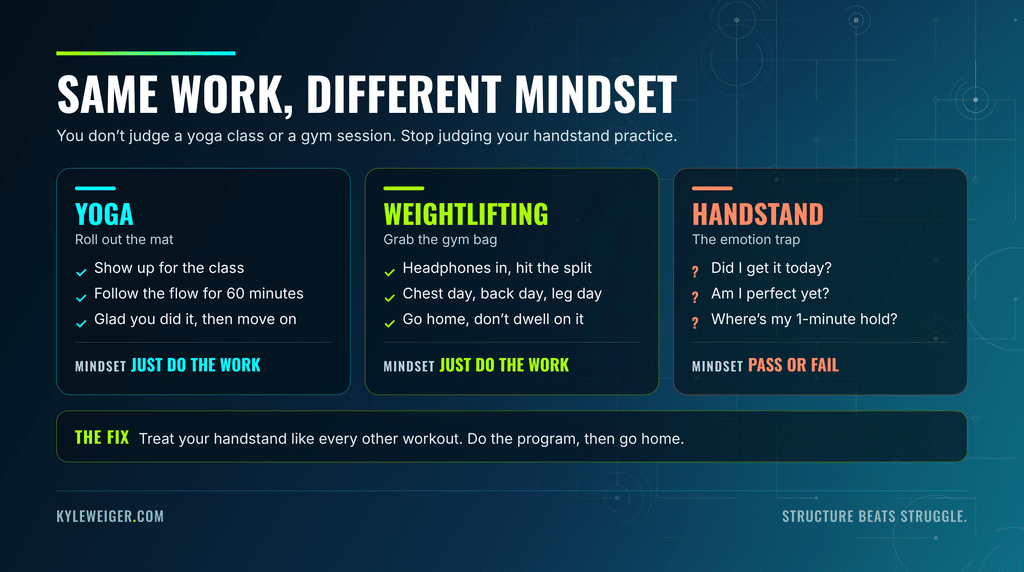
When I go to yoga, I roll out my mat, and I’m there for 60 minutes. I follow the instructor’s flow. And at the end, I’m just happy I did it, because I know it’s good for me. It’s helping me build a better body and a better mind.
I don’t walk out grading myself. I just showed up and did the class.
Think about the gym
It’s the same thing when I go to the gym. I wake up in the morning, grab my gym bag, head to the gym, throw my headphones in, and hit chest, shoulders and triceps. Or back and biceps. Or maybe it’s leg day.
At the end of that session, I grab my gym bag, go home, and I don’t think about it for the rest of the day. It doesn’t weigh on me whether I hit a new PR on my bench press, or whether I got deeper into a yoga pose. I just do the work, because that’s what I do as a person.
Where handstand gets tricky
Your handstand training should feel the same way. But handstand is skill-based, and that’s where the trap comes in.
Suddenly, every session becomes a test. Did I get the skill or not? Did I finally get my 10-second hold? Did I finally get my handstand press? And if you didn’t get it that day, somehow the whole session feels like a failure.
But it’s not a failure. It’s just one more step in the process of you evolving and transforming.
Focus on your inputs
So when you practice, just do your program.
If you need help with programming, that’s what I’m here for. The 4 Essential Handstand Elements and The 8 Week Freestanding Protocol take all of the guesswork out of it for you, so you can show up and simply do the work.
Focus on your inputs, and the outputs take care of themselves. It’s the same idea James Clear writes about in Atomic Habits: build the system, and the results follow. I highly recommend taking that approach to your handstand training.
Emotion only gets in the way
Here’s the truth: emotion won’t help you. It will only hurt you.
If you look at your practice through the lens of everything you can’t do yet, you’re selling yourself short on everything you already can do. Think about all the skills you’ve already built and the progress you’ve already made. That counts.
Treat it like any other workout
So treat your handstand training like any other workout. It’s something you do as part of your routine, because you have long-term goals.
You don’t need those goals to happen in your next workout, or tomorrow, or even next week. You just know that if you stick with it long enough, they will happen eventually. In other words, be boring, and trust the process.
The mountain you’re climbing
You’re on a road right now, traveling down a path. And here’s the funny thing about the road to handstand: by the time you reach your first goal, you’re already eyeballing the next one.
It’s like climbing what looks like a really big mountain. From the bottom, you can’t see anything higher. But once you reach the top, you realize that mountain is just one of a hundred you could climb, and plenty of the ones in the distance are even bigger.
So it’s a never-ending journey. That’s exactly why the emotion of any one session doesn’t matter much. Enjoy the climb.
Try this in your next session
- Know your program before you start. Decide what you’re training, so there’s nothing to judge on the fly.
- Do the work. Follow the plan, the same way you’d follow a yoga flow or a gym split.
- Grab your bag and go home. When the session’s done, it’s done. No grading, no replaying.
Keep building with me
If this helped, come train with me on social. I share drills, form checks and coaching breakdowns for adult handstanders at every stage of the roadmap.
- Instagram: @kyleweiger
- TikTok: @handstandcoach
- YouTube: youtube.com/kyleweiger
- Facebook: Kyle Weiger Handstand Coach
Show up, do the work, and go home. You’re on the right path, my friends.
Structure beats struggle.