
Kyle Weiger
Share This
Why handstand mistakes aren’t the real problem
Most handstand mistakes happen fast. In fact, a lot of them happen before you even know it.
Maybe your elbows bend a little. Then your shoulders soften. Or your hip flexes, and your foot does a little twitch like it’s swatting away a mosquito you didn’t invite.
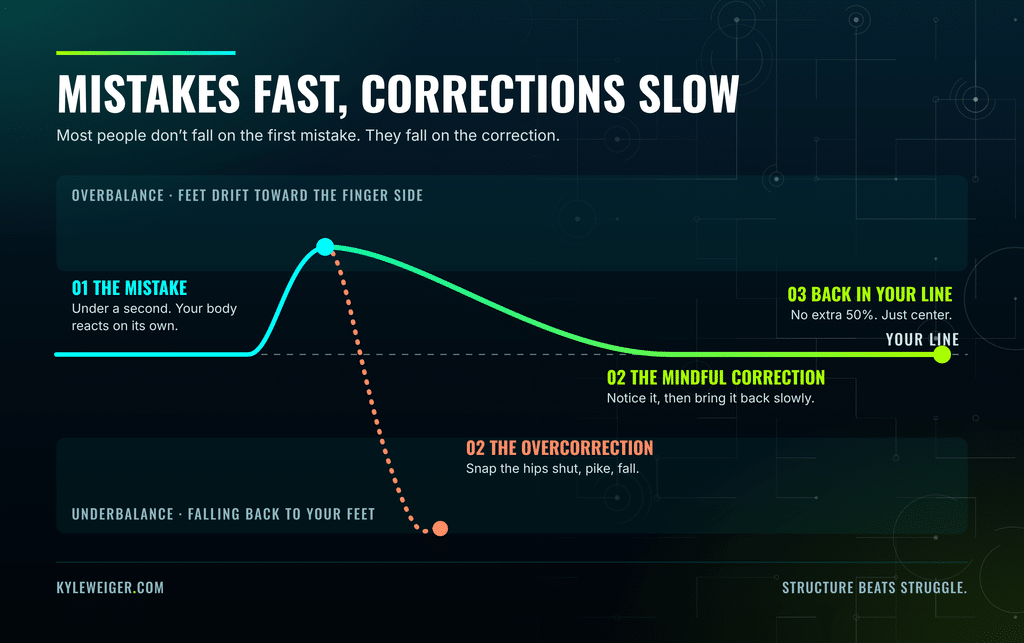
Here’s the thing, though: those mistakes aren’t what knock you down. Most people don’t fall on the first mistake. Instead, they fall on the second one, the correction.
So let’s talk about why that happens, and how to fix it.
Mistakes happen at the speed of your nervous system
When your body makes an adjustment, it usually happens quickly. These little shifts happen almost at a nervous system level. In other words, they’re closer to a reflex than a decision. Your body is simply reacting, adapting and adjusting to keep you up.
That’s normal. In fact, it’s part of balancing upside down. You can’t stop every mistake from happening, and you don’t need to.
What you can control is what you do next.
The overcorrection: where most falls come from
Here’s a very common example. You kick up, and you almost find your balance. Then you feel your feet start drifting toward the finger side of the handstand. That’s overbalance, and it happens in under a second.
So what do most people do? They snap their legs shut by piking, or closing the hips. Because they try to fix the mistake as fast as it happened, they throw themselves just as fast into underbalance. Then they fall out of the handstand.
There’s a reason we call it an overcorrection: you corrected way more than you needed to. The first mistake moved you a little off your line. However, the correction moved you a lot off your line, just in the other direction.
The fix: bring it back slowly
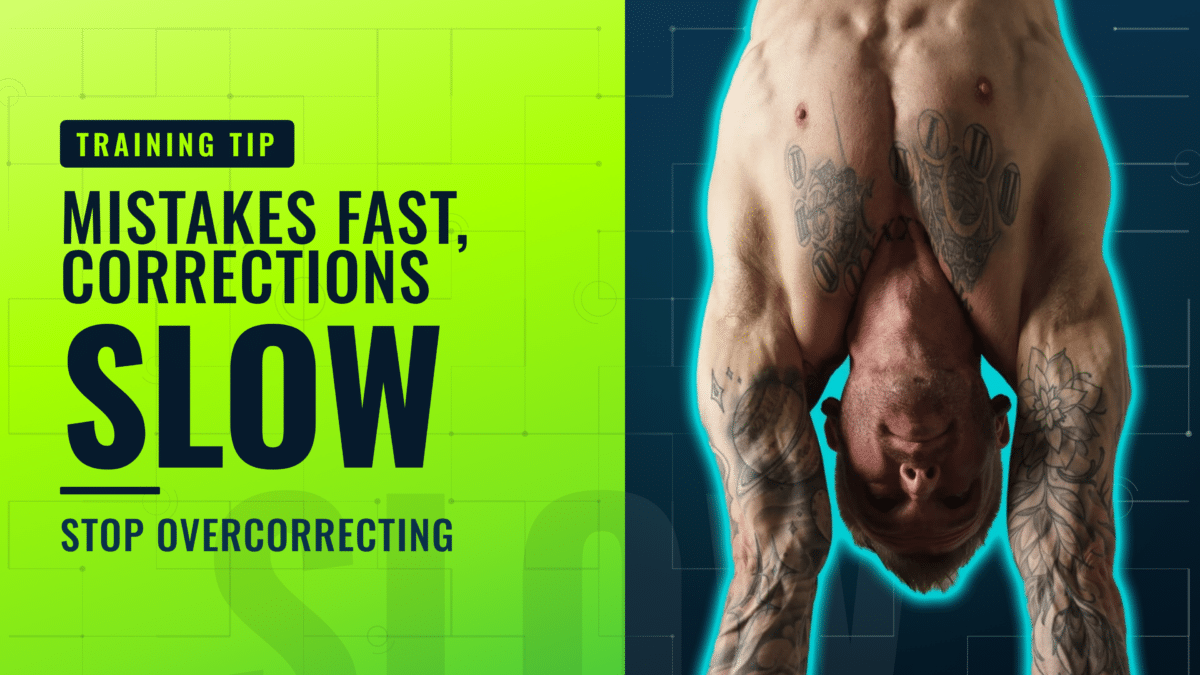
The goal isn’t to never make handstand mistakes. Instead, the goal is to recognize a mistake while it’s happening, then put that piece of the puzzle back slowly.
If your hips drift over, bring them back to where they were. You don’t need to bring them back to where they were plus 50%. Just return to the middle of the line where your handstand sits.
Think of it like steering a car on the highway. When you drift a little toward the lane line, you ease the wheel back. You don’t yank it, because yanking sends you into the other lane. Your handstand works the same way.
Mistakes happen quickly, because that’s your body adapting. Corrections, on the other hand, should be mindful and intentional.
How to catch your handstand mistakes in practice
You can’t fix what you can’t see. So here’s how to build this into your practice:
- Always film. Set up your camera and record 5 to 10 minutes of kicking up. Don’t try to nail a perfect rep every time. Just practice normally and let the camera roll.
- Look for the first mistake. When you watch it back, you’ll find a few moments where something shifted. For example, maybe your shoulders lost their push, or your hips went over and then snapped back.
- Watch what happened next. Did you ease back to center, or did you yank it? Most of the time, the fall comes right after the snap.
- Practice slow returns. On your next kick-ups, when you feel a drift, bring just that one piece back. Then pause in your line before you do anything else.
The video camera really is your best friend here. After all, it shows you what your body did in that split second you couldn’t feel.
Build balance you can count on
Learning to correct calmly is a big part of turning a few lucky seconds into a handstand you can actually hold. That’s exactly what we work on in The 8 Week Freestanding Protocol. Each week gives you a structured plan for your balance work, so you spend your sessions practicing the right corrections instead of guessing. I designed it for people who can kick to the wall with no problem and have caught a few seconds freestanding, but now want those seconds to show up consistently.
Keep building with me
If this helped, come train with me on social. I share drills, form checks and coaching breakdowns for adult handstanders at every stage of the roadmap.
- Instagram: @kyleweiger
- TikTok: @handstandcoach
- YouTube: youtube.com/kyleweiger
- Facebook: Kyle Weiger Handstand Coach
Let the mistake happen, then bring it back slowly. You’re on the right path, my friends.
Structure beats struggle.