
Kyle Weiger
Share This
How to Overcome Fear of Falling in Handstands: Why You’re Scared and What to Do About It
“I know I should just kick up and try, but I’m terrified of falling backward.” Many people experience a fear of falling in Handstand when first learning the skill.
I hear this constantly. Students who intellectually understand what they need to do, who have the strength and mobility required, who’ve watched all the tutorials and know the mechanics. But they can’t get past the fear.
They approach the handstand, hesitate, maybe do a tiny hop with one foot barely leaving the ground, and bail before they even get close to inverted. The fear of falling backward is so strong that it completely overrides everything else.
Here’s what you need to understand: this fear is completely normal, neurologically hardwired, and entirely manageable once you know how to work with it.
After coaching thousands of students through this exact barrier, I can tell you that fear of falling isn’t a character flaw. It’s your nervous system doing exactly what it’s designed to do: protect you from perceived danger.
Let me show you how to work with your nervous system instead of fighting it, and how to systematically build confidence so fear stops controlling your practice.
Why Your Brain Thinks Handstands Are Dangerous
Your fear isn’t irrational. From your brain’s perspective, being inverted with your feet above your head is dangerous.
Your amygdala (the threat-detection center of your brain) is constantly scanning for potential harm. And inversion triggers every alarm it has:
You’re in an unfamiliar position. Humans didn’t evolve to spend time upside down. Your vestibular system (which controls balance and spatial orientation) is getting signals it’s not used to processing. Unfamiliar equals potential threat.
You’re out of control. When you’re upright, you can see where you’re going, react quickly to changes, and move easily. Inverted? Your visual field is limited, your reactions feel slower, and movement feels awkward. Loss of control equals danger.
Falling could hurt. Your brain knows that landing on your head, neck, or back from a failed handstand could cause real injury. It’s not wrong about this. The risk is real, even if it’s manageable with proper technique.
So your amygdala does what it’s designed to do: it floods your system with stress hormones, creates tension throughout your body, and screams at you to abort the attempt.
This is biology, not weakness.
Understanding this helps because you stop judging yourself for being afraid. Your brain is just trying to keep you safe. The solution isn’t to override the fear through willpower. It’s to systematically show your nervous system that handstands are actually safe.
The Fear Cycle That Keeps You Stuck
Here’s what happens when fear runs your practice:
You approach a handstand attempt already anxious. Your body is tense before you even place your hands on the ground.
You kick up hesitantly, maybe getting one foot off the ground but immediately bailing because the fear spikes the moment you start to invert.
You don’t fall (because you bailed), which temporarily relieves the anxiety. Your nervous system learns: “Bailing keeps me safe.”
Next attempt, the fear is even stronger because you’ve reinforced the pattern. You bail again, even earlier this time.
This is a fear cycle. Each time you bail without actually experiencing what happens when you commit to the movement, you’re teaching your nervous system that the threat is real and avoidance is the solution.
The fear gets stronger, not weaker, because you never give yourself the chance to learn that you can handle it.
Breaking this cycle requires a different approach.
Step 1: Learn to Bail Safely (This Changes Everything)
The biggest thing keeping you stuck is not knowing what to do if you actually do fall backward.
Your brain is catastrophizing: “If I go over, I’ll land on my head and break my neck.”
So let’s take that fear off the table completely: learn to bail safely.
A proper handstand bail is simple, safe, and becomes automatic with a little practice. Here’s how:
The cartwheel bail: As you feel yourself going over, twist your hips to one side and step down one foot at a time, like a cartwheel. This is the most natural bail for most people and feels very controlled.
The tuck and roll bail: Tuck your chin to your chest, bend your arms slightly, and roll out over your shoulder (not your head). This is actually fun once you get used to it, like a backwards somersault.
The pirouette bail: Pivot on one hand and turn 180 degrees, stepping down facing the opposite direction. More advanced, but very smooth once you learn it.
Practice these bails deliberately. Don’t wait until you’re panicking in a handstand. Practice them against a wall where you can control the movement. Go over intentionally and execute the bail cleanly.
Once you know you can safely exit a handstand that’s going over, the fear loses most of its power. You’re not afraid of falling anymore because you know exactly what to do when it happens.
This is the game-changer that most students skip. They try to build confidence without ever addressing the core fear. Learn to bail first, and everything else gets easier.
Step 2: Use the Wall to Build Familiarity Without Fear
The wall is your best tool for desensitizing your nervous system to inversion.
When you practice against a wall, you remove the variable of falling backward. The wall catches you. You can focus entirely on getting comfortable being upside down without the fear component.
Here’s the progression:
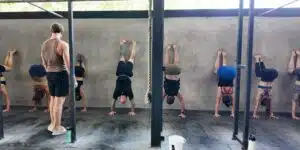
Start with chest-to-wall holds where you walk your feet up the wall. Your face is close to the wall, your back is to the room. This position feels very safe because you’re not going anywhere.
Hold this position for time. 20 seconds, 30 seconds, 60 seconds. Just exist upside down. Let your nervous system learn that being inverted isn’t dangerous.
Progress to back-to-wall holds where you kick up with the wall behind you as safety. You’re more exposed here, but the wall is still there if you need it.
Gradually reduce your reliance on the wall. Practice holds where your heels barely touch, where you’re actively balancing and the wall is just a backup.
The key is exposure. The more time you spend inverted in a safe context, the more your amygdala learns that inversion isn’t a threat. This is called habituation, and it’s how you retrain fear responses.
You’re not pushing through fear with willpower. You’re systematically showing your nervous system that the thing it’s afraid of is actually manageable.
Step 3: Practice Controlled Entries, Not Wild Attempts
Part of what makes handstands scary is the feeling of being out of control.
When you kick up with wild momentum, hoping to somehow land in a balanced position, you’re reinforcing the sense that handstands are chaotic and unpredictable. This feeds the fear.
Controlled entries do the opposite.
When you kick up with just enough momentum to reach vertical, when you can feel your hips arriving over your shoulders, when the movement is repeatable and predictable, handstands start to feel less like chaos and more like a skill you’re executing.
This sense of control is what allows confidence to build.
Practice this:
- Stand closer to where your hands will be (reduces needed momentum)
- Focus on bringing your hips over your shoulders, not launching your feet to the ceiling
- Make each entry look and feel the same (repeatability builds confidence)
- Do 5-10 quality controlled entries in a session, even if you don’t hold balance yet
The goal isn’t to stick a long hold. The goal is to prove to yourself that you can control the entry. This control translates to confidence.
Step 4: Reframe What “Falling” Actually Means
Language matters. The word “falling” carries a lot of negative weight.
Falling sounds dangerous, out of control, like something bad happening. No wonder you’re afraid of it.
Here’s a reframe: you’re not “falling.” You’re exiting the position.
Sometimes you exit on purpose (because you bailed). Sometimes you exit because you tipped past your balance point. But it’s just an exit. It’s part of the practice. It’s how you collect data about where the balance point actually is.
Elite handstand practitioners don’t see coming down as failure. They see it as feedback. “I went a bit too far forward that time. Next attempt, I’ll adjust.”
When you stop catastrophizing exits and start seeing them as information, the emotional charge around them decreases. Less emotional charge equals less fear.
Step 5: Build Confidence Through Small Wins
Confidence isn’t built by attempting something terrifying and hoping you don’t die. It’s built through a series of small, achievable wins that prove to your nervous system you’re capable.
Here’s the progression:
Win 1: I can hold a chest-to-wall handstand for 30 seconds.
Win 2: I can kick up to a back-to-wall handstand without crashing.
Win 3: I can bail safely when I practice going over.
Win 4: I can do 5 controlled kick-ups in a row.
Win 5: I can hold a back-to-wall handstand with minimal wall contact.
Win 6: I can attempt a freestanding handstand and exit cleanly.
Win 7: I can catch brief freestanding balance for 2-3 seconds.
Each of these wins is evidence that you’re progressing, that you’re capable, that the fear was lying to you about how dangerous this is.
Stack enough small wins, and confidence becomes your baseline instead of fear.
The mistake most students make is trying to jump straight to the big scary thing (freestanding handstand) without building the foundation of smaller wins first.
Be patient. Celebrate the small victories. They’re what create the confidence that eventually allows you to attempt the bigger challenges.
Step 6: Practice With Someone You Trust
Fear is amplified when you’re alone. Having another person present, especially someone who knows what they’re doing, can dramatically reduce anxiety.
A spotter or coach provides:
Physical safety (they can catch you if you go over, though you probably won’t need this if you know how to bail).
Emotional support (someone telling you “you’ve got this” when you’re hesitating makes a real difference).
Technical feedback (they can tell you what’s actually happening versus what you think is happening).
Accountability (it’s harder to bail on an attempt when someone is watching and encouraging you).
If you’re working through fear, don’t go it alone. Practice with a friend, hire a coach for a few sessions, or join a class where there’s supervision and support.
The social context changes the fear response. You’re less likely to catastrophize when someone else is calm and confident about what you’re doing.
Step 7: Accept That Some Fear Will Always Be There
Here’s something most people don’t want to hear: the fear never completely goes away.
Even after years of practice, there’s still a small voice in your head when you attempt something at your edge. It’s quieter, more manageable, but it’s there.
This is actually good. That small amount of fear keeps you attentive, focused, and respectful of the skill. It prevents complacency that leads to injury.
The goal isn’t to eliminate fear. It’s to change your relationship with it.
Instead of letting fear control your decisions (“I’m too scared to try”), you acknowledge it and proceed anyway (“I notice I’m nervous, and I’m doing this anyway”).
This is courage. Not the absence of fear, but the willingness to act despite it.
Over time, as you prove to yourself again and again that you can handle the thing you’re afraid of, the fear’s volume gets turned down. It becomes background noise instead of a siren.
But it never fully disappears. And that’s okay.
The Timeline: How Long Before Fear Stops Controlling You?
This varies by person, but here’s what I typically see:
Weeks 1-2: Learning to bail safely and building wall confidence. The fear is still strong, but you’re building tools to manage it.
Weeks 3-6: Controlled entries start feeling more familiar. The fear is present but no longer paralyzing. You can attempt freestanding handstands even though you’re nervous.
Months 2-3: You’ve had enough successful attempts that your nervous system starts to relax. Fear is still there for new challenges, but basic handstand attempts don’t spike anxiety like they used to.
Months 6+: Fear becomes a minor background presence rather than the dominant force in your practice. You’re confident in your ability to handle whatever happens.
The key is consistent exposure. If you practice sporadically, the fear resets because your nervous system doesn’t get enough repetition to habituate. Practice regularly (even if sessions are short), and the desensitization happens steadily.
The Bottom Line: Fear Is Normal, and You Can Work With It
You’re not broken or weak for being afraid of falling in a handstand. Your brain is doing exactly what it’s designed to do.
The solution isn’t to override fear through willpower or to judge yourself for having it. The solution is systematic desensitization: learn to bail safely, build familiarity through wall work, practice controlled entries, reframe exits as feedback, stack small wins, and practice with support.
Do this consistently, and the fear that currently feels overwhelming will become manageable background noise.
You won’t eliminate it completely. But you’ll change your relationship with it enough that it stops controlling your practice.
Fear doesn’t have to be the thing that keeps you from handstands. It can be the thing that makes you more patient, more deliberate, and ultimately more skilled.
Ready to Build Confidence Systematically?
If you want a proven system that takes all the guesswork out of learning handstands, I’ve put together a free resource that covers exactly what you need to get started the right way.
[Download my free 21 Foundational Handstand Habits series]
Over 21 days, you’ll get the essential habits, drills, and principles that set serious handstand students apart from those who spin their wheels for years. No information overload—just the right things, in the right order.
The fear is real. The solution is real too. Let’s build your confidence together. See you upside down.
PS: Follow me on socials: Instagram, Facebook, TikTok, Reddit