Kyle Weiger
Share This
Choosing handstand drills is like shopping for clothes
Picture this. I walk into a clothing store and try on a men’s triple-XL hooded sweatshirt. I’m 5’9” and about 155 pounds, so that hoodie is far too big for me. I’m not going to buy it. Why would I invest money in something I’d never get any use out of?
Choosing handstand drills works exactly the same way. Not every drill fits every practitioner. So the goal is simple: find the version that fits you right now.
Your right size, plus about 10%
You want drills that fit where you are today, and drills that fit where you’ll be in about a month or two.
Here’s the general rule: go with your right size, plus about 10%. That little extra stretch keeps you growing, without handing you something you can’t actually use yet.
What “too big” looks like
Let’s say you’re still learning to kick up to the wall and land softly. Good news: there are a lot of great drills for exactly that.
But jumping ahead to slamming into the wall so you can shift over to one arm? That’s a triple-XL hoodie. Those drills don’t fit where you are, so they won’t serve you.
A few signs a drill is too big for you right now:
- You’re still learning to kick up.
- You’re holding for about 10 seconds.
- You’re already trying to shift to one arm.
And here’s the thing about a drill that’s too big: it’s a bad investment. You get no use out of a drill you can’t do yet, just like a shirt that doesn’t fit.
What the right fit feels like
The right drill challenges you. It makes you feel like you’re doing good work, and it leaves you with a real sense of accomplishment. At the same time, it’s still challenging enough that you know you can keep getting better at it.
That’s a drill you can actually use. It’s time well invested, and it gives you progress you can build on.
What about drills that feel too easy?
To be clear, fundamentals always matter. Nothing on this site will ever tell you to skip the basics.
But there’s a difference between practicing your fundamentals and repeating the same drill over and over without progressing it. If a drill never challenges you anymore, you’re in maintenance mode. You’re not really training.
That’s why I tell people to be boring, but never stuck. Do the same fundamentals, and keep doing them a little better each time.
How to find drills that fit you
Here’s how to try a drill on:
- Check the prerequisites. Can you already do the skills this drill builds on?
- Progress it if it’s too easy. Add time, add difficulty or move to the next version.
- Regress it if it’s too hard. Step back to a version you can actually do well.
The good news is that there’s almost always a progression or a regression that makes a drill fit you.
Why a coach helps
This is where the art of having a coach really pays off. A good coach helps you decide which drills fit you right now, and teaches you the progressions, so you can keep growing instead of guessing.
If you want that kind of guidance, I offer one-on-one coaching, where we find the drills that fit your practice together. And whoever you work with, choose your coach carefully.
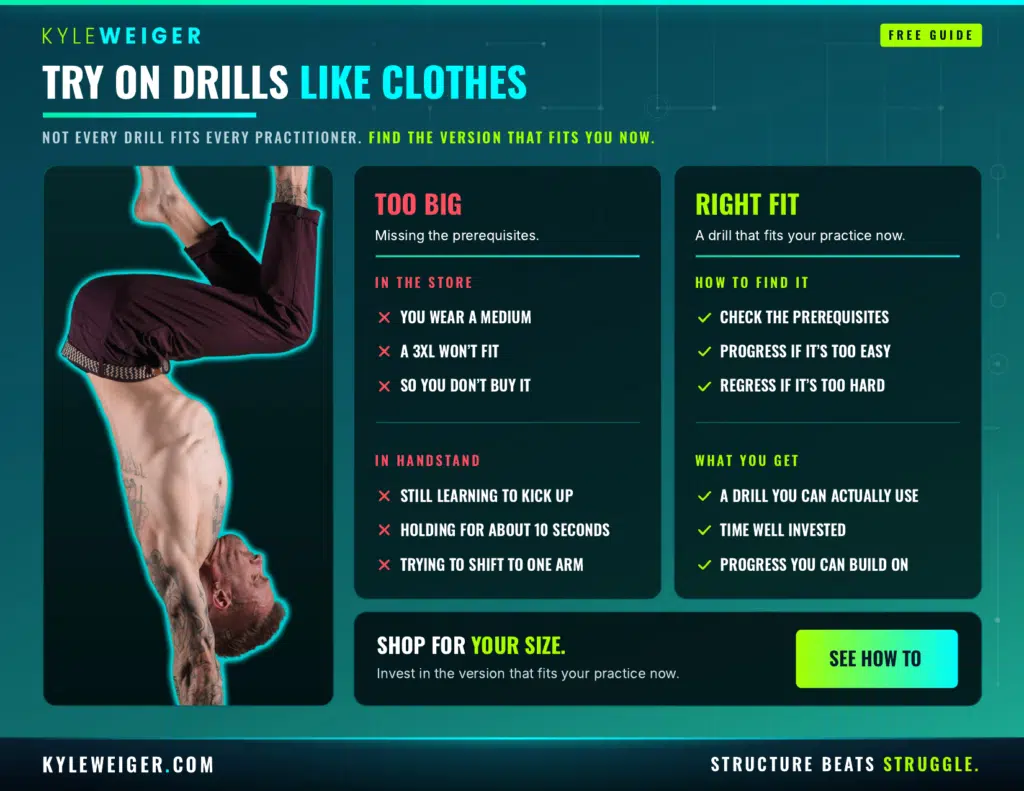
Download the drills like clothes guide
Want this on hand while you train? Download the free digital guide. It lays out what too big looks like, what the right fit looks like, and how to find it.
Keep building with me
If this helped, come train with me on social. I share drills, form checks and coaching breakdowns for adult handstanders at every stage of the roadmap.
- Instagram: @kyleweiger
- TikTok: @handstandcoach
- YouTube: youtube.com/kyleweiger
- Facebook: Kyle Weiger Handstand Coach
Shop for your size, and invest in the version that fits your practice right now. You’re on the right path, my friends.
Structure beats struggle.