
Kyle Weiger
Share This
The coveted 1-minute handstand
The 1-minute handstand is a big goal for most intermediate students. Sixty seconds upside down, no wall, no support. So how do you actually get there?
It comes down to a balance between strength and technique.
On one hand, you need a certain amount of endurance, stamina and conditioning. Your shoulders have to handle 60 seconds of upside-down body weight with no support. On the other hand, you need good technique. When you hold a proper straight-line handstand, you get a lot more mileage out of the strength you already have.
My ethos on this is simple: good technique extends your gas tank.
Find your cruise control
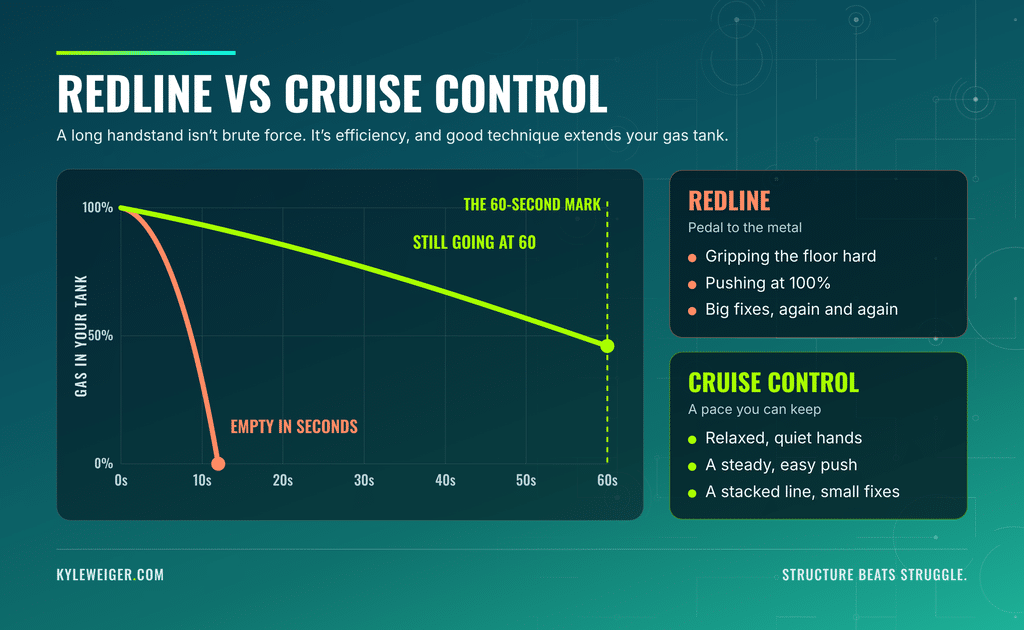
Imagine you’re driving down the highway with the pedal to the metal. You redline it and top out your speed. You wouldn’t get very far before you ran out of gas.
That’s why cruise control exists. You find a cruising speed your engine can easily maintain, and then you go the distance.
Your handstand works the same way. Think of a sprint versus a marathon. You can sprint at max effort for about 10 seconds before you’re wiped out. However, to go a long distance, you have to manage your output and your breath. A long handstand needs that same kind of pacing.
How I trained for my first minute
When I trained for my first minute, I split my training into separate days: strength days and technique days.
Strength days
On strength days, I did anything that could make me physically stronger:
- Endurance holds at the wall
- Ankle weight training
- Handstand shrugs
- Push-ups
- Hollow bodies
- L-sits on parallettes
- Lots of core work
As a result, everything from my hands, elbows and triceps to my shoulders, chest and core got incredibly strong.
Technique days
On technique days, I worked on arriving in a clean line. I opened my shoulder position and tucked my hips, so all of my joints stacked in one clean line.
That way, I wasn’t constantly dipping forward and then spending extra energy pulling my shoulders back. I also wasn’t letting my abdominal wall fly open into a banana back, which would force me to make another fix.
Every fix costs you energy
Here’s the key idea: each fix you make in a handstand costs you calories. So you want to think about your handstand in terms of energy expenditure.
A long handstand usually isn’t the result of brute force. In fact, it’s the opposite. It’s the result of efficiency.
Efficiency starts at your hands
To hold longer, you need to be efficient all the way up, starting with your hands.
- Your hands: don’t grip the ground so hard that you stress out the muscles in your forearms.
- Your shoulders: keep pushing up, but not at 100%. Find your cruise control, a push you can keep up without going max effort.
- Your breath: manage it the same way a runner does on a long run, calm and steady.
Train both at the same time
So the goal is to build your endurance and conditioning while you also work on your technique. That includes the way you stack, how you kick in, how you arrive and how you manage your breath. Those are all technique, and they all add seconds to your hold.
Try this in your next week of training
- Split your days. Give strength and technique their own training days, so you can focus on one at a time.
- Pick your strength work. Choose a few moves from the strength list above and build them up gradually.
- Check your effort on every rep. Ask yourself: am I at cruise control, or am I redlining? Then dial it back if you need to.
Train strength and technique with a plan
If you want help working on both, The 8 Week Freestanding Protocol has two training blocks: a strength block and a technique block. That way, you can isolate each element and work them in a staggered approach. You’ll hit your handstand with razor-sharp accuracy, and you’ll build the baseline strength to hold it for the coveted 1-minute mark.
Keep building with me
If this helped, come train with me on social. I share drills, form checks and coaching breakdowns for adult handstanders at every stage of the roadmap.
- Instagram: @kyleweiger
- TikTok: @handstandcoach
- YouTube: youtube.com/kyleweiger
- Facebook: Kyle Weiger Handstand Coach
Find your cruise control, and the minute will come. You’re on the right path, my friends.
Structure beats struggle.