
Kyle Weiger
Share This
What your handstand margin of error means
When you’re new to handstand, your margin of error is almost nothing. You have to get everything just right to hit it. A slight overkick, and you fall toward your fingers. On the other hand, a slight underkick brings you right back down to the ground.
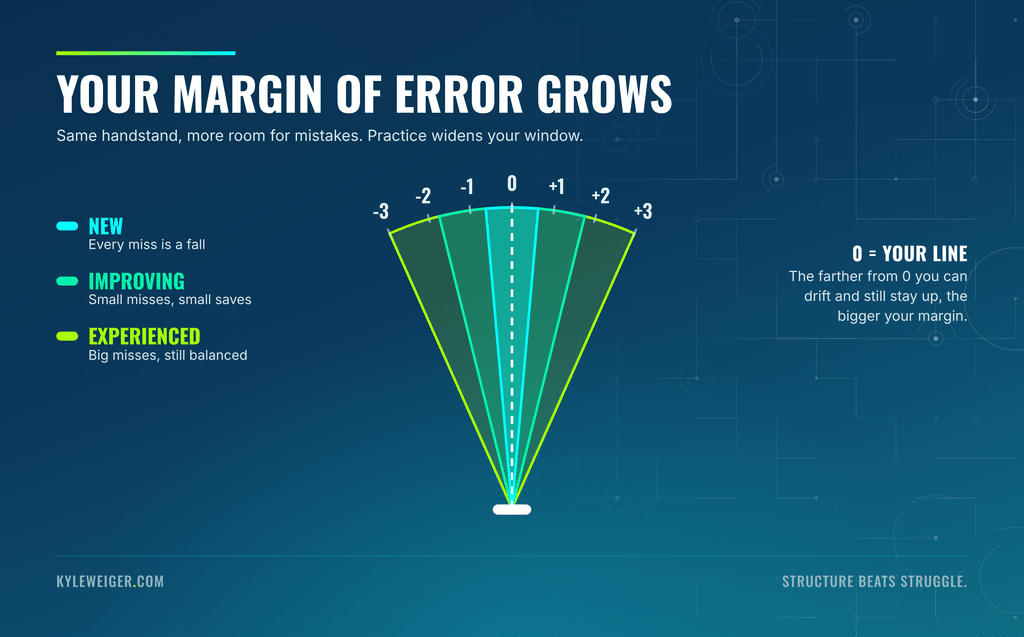
Picture a vertical line. That’s the handstand you’re going for. For someone new, the handstand margin of error is two lines angled out from the base at a very small angle. Stay inside them and you’re up. Drift outside them and you’re down.
Now think of that vertical line as 0, like on a graph. As you get better, your window opens to 1 and -1, then 2 and -2, then 3 and -3. In other words, the numbers keep expanding as your handstand improves.
The same goes for mistakes
This doesn’t just apply to your kick. It applies to your balance, too.
When you’re new and you finally catch your balance, you’re not really allowed to make any mistakes. That’s because your margin of error is so slim for both the kick and the balance. As a result, every mistake turns into a fall.
However, as you move through acquiring, refining and maintaining the skill, your margin of error gets bigger. I can make a much bigger mistake as an experienced handstander and still stay up than I ever could when I was new.
From one mistake, one fall, to one mistake, one correction
So here’s the shift you’re working toward. As a beginner, one mistake equals one fall. Then, as you get better, every mistake simply becomes a correction you make while you stay balanced.
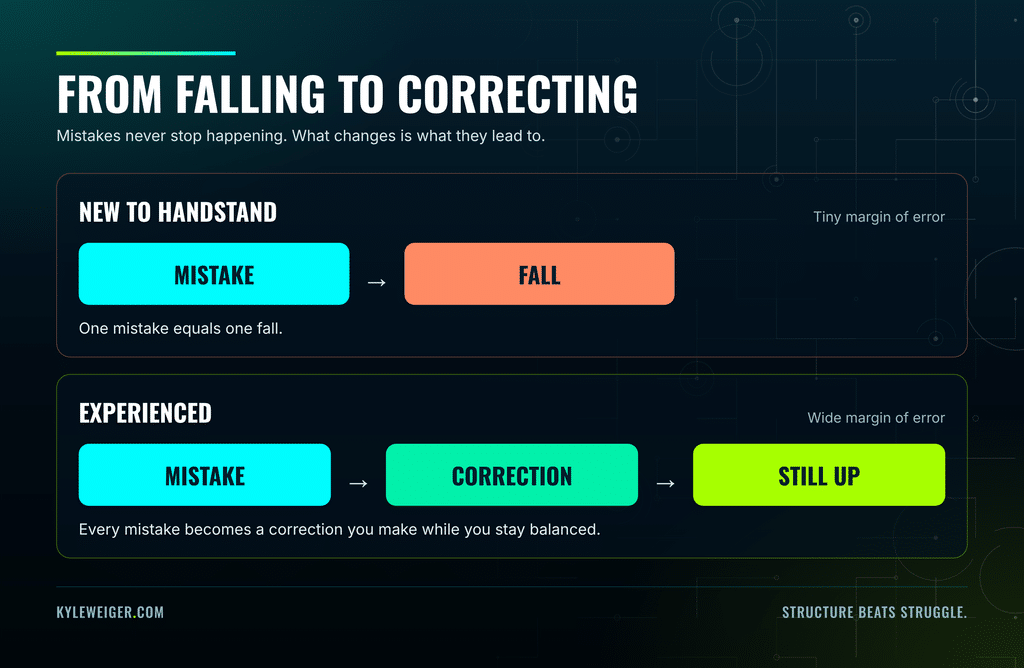
You may have already noticed this in your own practice. Maybe you made a mistake, but you caught it. Maybe you thought, hey, I saved it, or hey, I didn’t fall. Or maybe you actually pushed back up through your shoulders and corrected the handstand. That’s your margin of error growing.
Practice doesn’t make you perfect
Practice won’t make your handstand perfect. Instead, it keeps you up for longer, so you can recognize mistakes before they happen.
There are technique mistakes everyone makes along the way, whether it’s the way you kick, the way you land at the wall, or what you do with your shoulder or hip position. Over the course of a long-term practice, you get more in tune with your body. Those lessons get baked into your neurophysiology, so they become much easier to recognize.
Try this in your next session
Next time you save a handstand, pause and notice what you did. Did you push back up through your shoulders? Did you bring your hips back over your hands? Each save is proof that your margin of error is getting bigger.
Widen your margin
If you’re catching a few seconds freestanding and want those saves to happen more often, The 8 Week Freestanding Protocol is built for exactly that stage. I designed it for people who can kick to the wall with no problem and have caught a few seconds freestanding, but now want those seconds to show up consistently.
Keep building with me
If this helped, come train with me on social. I share drills, form checks and coaching breakdowns for adult handstanders at every stage of the roadmap.
- Instagram: @kyleweiger
- TikTok: @handstandcoach
- YouTube: youtube.com/kyleweiger
- Facebook: Kyle Weiger Handstand Coach
Keep practicing, keep catching your saves, and watch your margin grow. You’re on the right path, my friends.
Structure beats struggle.