
Kyle Weiger
Share This
Why handstand breathing matters
Handstand breathing is one of those things nobody thinks about until it goes wrong. You kick up, find your balance, and then you notice you’re holding your breath. Or worse, you’re breathing like you just ran up three flights of stairs.
Here’s the goal: your handstand should be a calm, relaxing, enjoyable experience. In fact, it should be something you can hold for a good amount of time, not a short, explosive burst of energy.
So the way you breathe makes a bigger difference than most people expect.
Your handstand is a long run, not a sprint
Managing your breath in a handstand is a lot like managing your breath on a long run. Imagine you set out to run 10 miles, but you sprint the first 400 meters. You’d be out of breath before the first mile was over, because you didn’t manage your breath or your output.
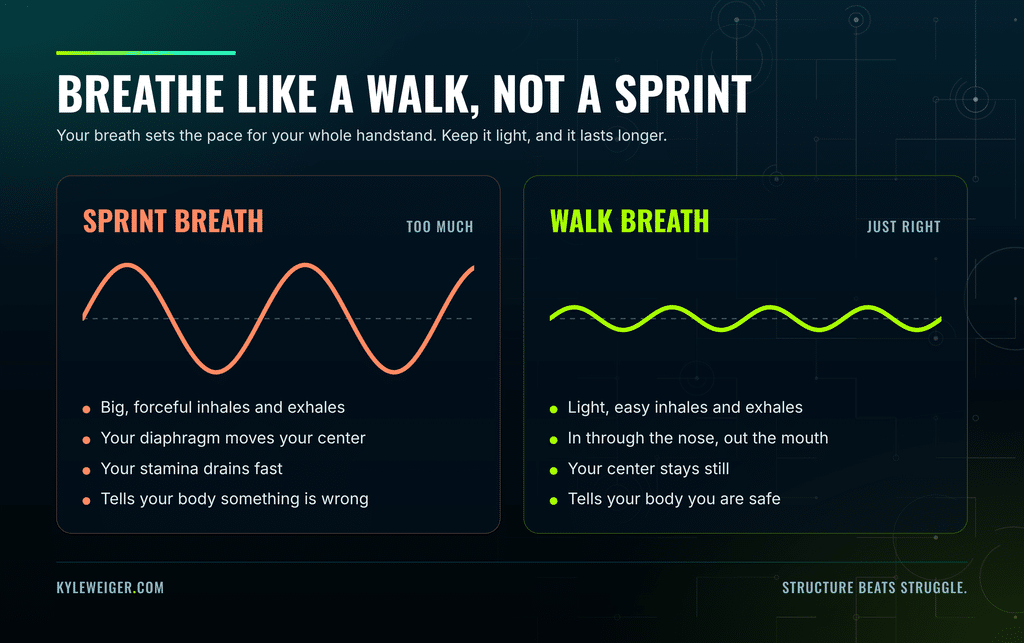
Your handstand works the same way. When you breathe hard, with big, powerful inhales and exhales, you shorten the shelf life of your hold.
Instead, I think of my breath in a handstand like I’m out for a casual walk on a sunny afternoon. Light, fresh and easy. I’m not trying to go fast or powerful with my breath at all.
Attention, yoga students
This is where handstand breathing differs from what you might learn in yoga class. And that’s not a criticism of yoga in any way. It’s just a different goal.
If your yoga teacher cues you to breathe deeply into ujjayi breath, with big, forceful exhales, that works against you upside down for two reasons:
- It drains your stamina. Big breaths take a lot of energy. As a result, you run out of gas sooner, just like the runner who sprinted the first lap.
- It moves your center. The deeper your breath, the more your diaphragm moves. However, you don’t want the center of your body moving in a handstand. We’re trying to keep everything still, so anything that moves your middle makes balancing harder.
How to breathe in your handstand
So what should you do instead? Good handstand breathing is shallow and easy:
- Easy inhale, easy exhale. No big gulps of air and no forceful pushes.
- In through the nose, out through the mouth. It keeps the rhythm light and steady.
- Match your walking pace. Think sunny afternoon stroll, not a race.
Your breath also sends messages to your mind and your nervous system. With every easy breath, you’re telling your body: we’re okay, we’re safe, there’s no danger here. You’re balanced, and you don’t need to force anything.
That calm is what lets your handstand settle in and last.
Try this in your next session
Next time you’re upside down, notice your breath before anything else.
- Kick up and find your balance. The wall works great for this.
- Check in: are you holding your breath, or breathing hard?
- Shift to small, easy breaths, in through the nose and out through the mouth.
- Then notice how much stiller your center feels.
Repeat that on every rep. Over time, the calm breath becomes your default.
Build holds that last
Calm breathing is a big part of turning a few seconds into a handstand you can count on. That’s exactly what we build in The 8 Week Freestanding Protocol. Each workout gives you a structured plan, so you spend your time upside down calm and focused instead of guessing. I designed it for people who can kick to the wall with no problem and have caught a few seconds freestanding, but now want those seconds to show up consistently.
Keep building with me
If this helped, come train with me on social. I share drills, form checks and coaching breakdowns for adult handstanders at every stage of the roadmap.
- Instagram: @kyleweiger
- TikTok: @handstandcoach
- YouTube: youtube.com/kyleweiger
- Facebook: Kyle Weiger Handstand Coach
Breathe easy, stay still, and enjoy the view. You’re on the right path, my friends.
Structure beats struggle.