
Kyle Weiger
Share This
I Can’t Get Open Shoulders in Handstand: The Mobility vs. Stability Problem
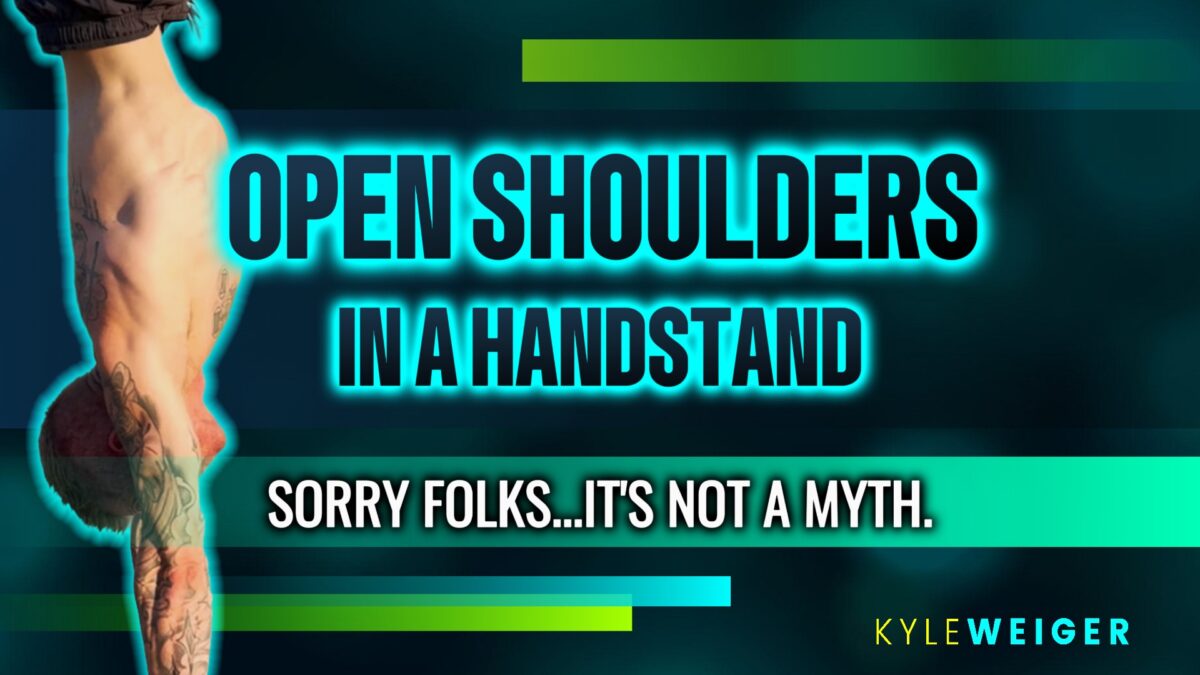
“I can’t get my shoulders open.” This is a common challenge for many people working on Open Shoulders In A Handstand.
This is one of the most common complaints I hear from handstand students. They feel stuck, restricted, like no matter how hard they try to push their shoulders up or get their arms overhead, something is blocking them.
And here’s what usually happens next: they assume it’s a flexibility problem and spend months stretching their shoulders, hoping that more mobility will solve everything.
Sometimes it does. But often, it doesn’t. Because shoulder “openness” in a handstand isn’t just about mobility. It’s about the relationship between mobility AND stability.
You can have all the flexibility in the world, but if you don’t have the strength to stabilize in that range, you won’t get open shoulders in a handstand when you’re inverted and under load. And conversely, you can have incredible shoulder strength, but if you lack the mobility to get into proper position, you’ll compensate somewhere else (usually your lower back).
After a decade of coaching, I’ve learned that most “shoulder problems” in handstands are actually about understanding what your shoulders need to do, why they’re not doing it, and how to address the actual limitation instead of guessing.
Let me break this down so you can figure out what’s actually going on with your shoulders and fix it.
What “Open Shoulders In A Handstand” Actually Means
First, let’s get clear on what we’re talking about.
When coaches say “open your shoulders” in a handstand, they mean full shoulder flexion with elevation. In practical terms:
Your arms are fully vertical, in line with your torso (not angled forward). Your shoulders are elevated, pushed up toward your ears (not collapsed or sunken). Your shoulder blades are upwardly rotated (not pulled down or squeezed together). There’s no compensation happening in your spine to get your arms overhead.
This position creates:
- Efficient skeletal stacking (bones supporting weight, not just muscles)
- Maximum stability in the shoulder joint
- A straight body line without arching
- Sustainable holds without early fatigue
Closed or restricted shoulders look like:
- Arms angled forward instead of vertical
- Shoulders sunken or collapsed
- Excessive arch in the lower back to compensate
- Feeling “stuck” or compressed when inverted
The question is: why can’t you achieve the open position?
Problem #1: You Actually Lack the Mobility
Let’s start with the obvious one. Some people genuinely don’t have enough shoulder flexion range to get their arms fully overhead without compensation.
Here’s the test:
Stand with your back against a wall, feet a few inches away from the wall. Try to raise your arms overhead until they touch the wall, keeping your lower back flat against the wall (no arching).
Can you get your arms all the way up with your biceps by your ears, ribs down, lower back flat? If yes, you have adequate mobility. If no, mobility is a limiting factor.
If you can’t do this, you need to work on shoulder flexion mobility.
The good news is that this is trainable. With consistent work, most people can develop the range they need in a few weeks to a few months.
What actually works:
Wall slides (standing or kneeling, focusing on keeping ribs down as arms go overhead). Foam roller shoulder stretches (lying lengthwise on a roller, letting arms relax overhead). Resistance band shoulder stretches (pulling the band overhead and behind you). Doorway stretches with one arm overhead, leaning through to open the front of the shoulder.
The key is consistency. Daily mobility work (even just 5-10 minutes) produces better results than occasional long sessions.
But here’s the critical part: mobility work alone won’t solve your handstand shoulder problem if stability is the missing piece.
Problem #2: You Have Mobility But No Stability
This is the one that surprises people.
You can lie on your back and get your arms fully overhead with no problem. You can do the wall test and pass easily. You have the range of motion.
But the moment you get into a handstand, your shoulders collapse, sink, or won’t elevate properly. What gives?
Here’s what’s happening: you have passive mobility but not active control in that range.
Passive mobility means your joint can access the position when there’s no load (like lying on the floor). Active control means you can stabilize and maintain that position when your muscles are working under load (like supporting your bodyweight inverted).
These are different qualities, and you need both.
Think of it this way:
You might be able to touch your toes when you’re relaxed and bending forward. But can you hold that position while someone pushes down on your back? That’s the difference between passive range and active stability.
You need open shoulders in a handstand to stabilize your entire bodyweight in an overhead position while making constant micro-adjustments for balance. If you don’t have the strength and neuromuscular control to do that, your shoulders will collapse or close even though you technically have the flexibility.
The fix: build shoulder stability in the ranges you need.
Scapular pushups (teaching upward rotation and protraction). Pike holds (shoulders loaded overhead, building time under tension). Handstand wall holds with active shoulder focus (thinking about pushing the ground away, elevating shoulders toward ears). Shoulder taps in plank position (building single-arm stability). Resistance band shoulder pulls (strengthening the muscles that create elevation).
You’re not stretching your way into open shoulders here. You’re strengthening your way into the ability to control and maintain the position under load.
Problem #3: You Don’t Understand the Cue “Open Your Shoulders”
Sometimes the issue isn’t mobility or stability. It’s that you literally don’t know what your coach is asking you to do.
“Open your shoulders” is vague. What does that actually mean in terms of muscle activation and movement?
Here’s what should actually be happening:
Your shoulder blades rotate upward (the bottom tips move out and away from your spine). Your shoulders elevate (they move up toward your ears, creating space). You push the ground away (active protraction of the scapula). Your upper traps and serratus anterior engage to create and maintain this position.
But if you’ve never been taught these specific actions, you might be doing something completely different when you hear “open your shoulders.”
Some students pull their shoulders down and back (the opposite of what you want). Others try to force their arms up without engaging the right muscles. Still others are doing the right thing but so subtly that it’s not creating enough change.
Better cues that create the right action:
“Push the ground away from you like you’re trying to make yourself taller.” “Shrug your shoulders up toward your ears.” “Make space between your shoulders and the ground.” “Think about reaching the ceiling with your fingertips.”
These cues create active engagement in the right direction instead of leaving you guessing.
If you’ve been trying to “open your shoulders” for months with no progress, the problem might be that you don’t actually know what action you’re trying to create. Get clearer cues or feedback from someone who can see what you’re doing.
Problem #4: Your Ribs Are Sabotaging Your Shoulders
This is sneaky and often missed.
Your rib position and your shoulder position are connected. When your ribs flare (lower ribs stick out and up), it changes the angle of your shoulder joint and makes proper shoulder flexion nearly impossible.
You can have all the mobility and stability in the world, but if your ribs are flared, your shoulders will never fully open because the skeletal positioning won’t allow it.
The compensation chain:
Ribs flare → Lower back arches → Shoulder angle changes → Arms can’t get vertical → Shoulders stay closed
Fix the ribs, and suddenly shoulder opening becomes much easier.
The fix:
Pull your ribs down and in (think about the position in a hollow body hold). Engage your core to prevent rib flare (bracing like someone’s about to punch you in the stomach). Practice the wall test with explicit focus on keeping ribs down as arms go overhead.
This isn’t a shoulder problem. It’s a core and rib positioning problem that manifests as a shoulder problem. Fix the foundation, and the shoulder issue often resolves itself.
Problem #5: You’re Compensating Somewhere Else
The body is a kinetic chain. When one link doesn’t work properly, other links compensate.
If you can’t get open shoulders in a handstand, your body will find another way to get your arms overhead. Usually, that compensation happens in your lower back (arching to make up for limited shoulder flexion) or your wrists (hyperextending to angle your arms differently).
These compensations allow you to look like you’re in a handstand, but they create instability, limit your progress, and often lead to pain or injury over time.
The problem: you’ve practiced with these compensations for so long that they feel normal. You might not even realize you’re doing it.
The solution: video yourself from the side. Look at your shoulder angle, your spine position, your wrist angle. Are your arms truly vertical, or are they angled forward? Is your back straight, or arched to compensate? Are your wrists in neutral extension, or hyperextended to make up for shoulder limitations?
If you spot compensations, you need to go back and address the root cause (usually mobility or stability in the shoulders) instead of continuing to reinforce the compensation pattern.
How to Know Which Problem You Have
Here’s a simple diagnostic process:
Test 1: Wall shoulder flexion test (described earlier)
- Can do it easily → mobility is fine, look at stability and cueing
- Can’t do it without arching → mobility is the issue
Test 2: Loaded shoulder position test
- Get into a pike position (hands on ground, hips high, straight arms)
- Try to push your shoulders toward your ears and elevate them
- Can you create and hold that position for 20+ seconds?
- If no → stability is the issue
- If yes → look at cueing and body awareness
Test 3: Video analysis
- Film your handstand from the side
- Look at shoulder angle and spine position
- Are you compensating with an arched back?
- Are your shoulders actually elevated when inverted?
- This reveals whether your issue is execution or understanding
Run through these tests honestly, and you’ll know exactly where to focus your work.
The Fix: Mobility + Stability + Proper Cueing
Most “shoulder problems” require work in multiple areas, not just one.
Your training should include:
Mobility work (daily stretching and range of motion exercises for shoulder flexion). Stability work (loaded positions that build strength in the ranges you need). Proper cueing (understanding what actions create shoulder opening). Body awareness (video feedback, coaching, learning to feel what’s happening). Core engagement (preventing compensations through rib flare and back arching).
This isn’t just “stretch more” or “get stronger.” It’s a comprehensive approach that addresses all the factors that allow your shoulders to open and stay open under load.
The timeline:
If mobility is your limitation, expect 4-8 weeks of consistent daily work to see significant improvement.
If stability is your limitation, expect 3-6 weeks of targeted strength work to build the control you need.
If cueing or body awareness is your limitation, this can improve in 1-2 weeks once you understand what you’re actually trying to do.
The key is identifying your specific limitation and working on that instead of just doing random shoulder exercises hoping something works.
The Bottom Line: Open Shoulders Require More Than Stretching
You can’t get your shoulders open in handstands not because you’re inflexible (though that might be part of it), but because shoulder opening is a combination of mobility, stability, proper muscle activation, rib positioning, and body awareness.
Stretch all you want, but if you don’t have the stability to control that range under load, your shoulders will still collapse when you’re inverted.
Build all the strength you want, but if you lack the mobility to get into position, you’ll compensate with your lower back and never achieve a clean line.
The solution is addressing all the pieces: mobility work, stability training, proper cueing, core engagement, and consistent feedback about what you’re actually doing.
Do this comprehensively, and shoulders that felt stuck for months will start to open. Your handstand line will straighten. Your holds will become more stable and sustainable.
Stop guessing. Start addressing the actual limitations.
Ready to Fix Your Shoulders Properly?
If you want complete session plans that manage warm-up, drill progressions, freestanding practice, and conditioning in the right proportions (not just guessing what to do each day), I’ve built systems specifically for this.
[Check out my 4 Essential Elements course] for comprehensive programming with structured sessions at every level. Level = New Beginner (mainly focused on wall-only drills).
[Or the 8 Week Freestanding Protocol] for focused progression from wall to consistent freestanding holds. Level = Beginner Plus (comfortable kicking in the middle of the room).
Both include the exact session structures, drill progressions, and timing that create results.
Train with structure. Respect the components. Progress consistently.
See you upside down.
PS: Follow me on socials: Instagram, Facebook, TikTok, YouTube