
Kyle Weiger
Share This
Stop “Grabbing the Ground” With Your Fingers: Why This Common Cue Creates Early Fatigue
Using your fingers in handstand comes with some nuance. Yes, you need them…but not in the way you’ve been told.
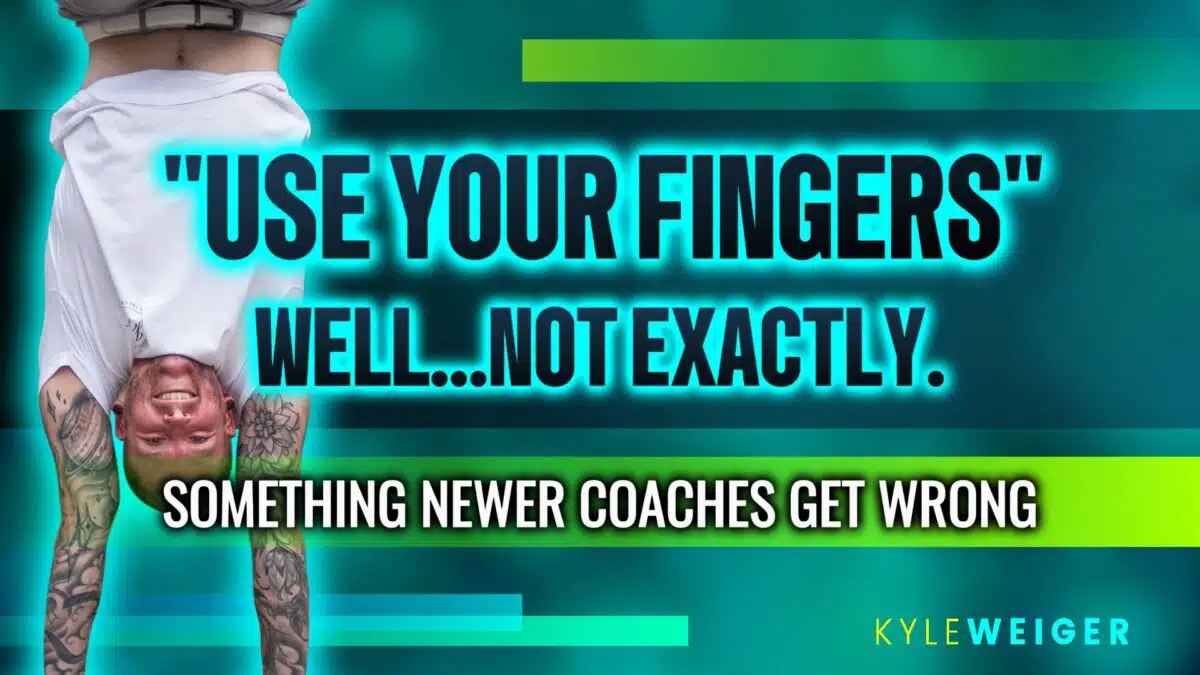
“Grip the ground with your fingers!”
“Dig your fingertips into the floor!”
“Grab like you’re holding onto a ledge!”
If you’ve taken a handstand class or watched YouTube tutorials, you’ve probably heard these cues. They’re everywhere in the handstand world, repeated by coaches who genuinely believe they’re helping students find better balance.
Here’s the problem: focusing too much on using your fingers in handstand is creating early fatigue and limiting your progress.
After a decade of coaching and refining my own practice, I’ve learned that overusing your fingers is one of the most common mistakes students make. And unfortunately, it’s often taught by coaches who haven’t yet figured out how to be more efficient with their own energy.
Let me explain why weight in the middle of your palm is actually the better approach, and how your fingers should function as guidance rather than your primary support system.
What Happens When You “Grab the Ground”
When students are told to grip aggressively with their fingers, here’s what actually happens in their body:
Your forearm muscles over-activate. The muscles responsible for finger flexion (primarily in your forearms) engage intensely to maintain that grip. These are relatively small muscle groups being asked to work continuously under load.
Fatigue sets in much faster. Those forearm muscles aren’t designed for sustained isometric contraction under your full bodyweight. They fatigue quickly, your hands start shaking, and your hold collapses long before your shoulders or core would give out.
You lose efficiency. Instead of distributing load across the larger, more stable structures of your hand and forearm (bones, ligaments, broader muscle groups), you’re relying on small muscles doing work they’re not optimized for.
Your actual balance suffers. When your forearms are maxed out trying to maintain grip, you lose the fine motor control needed for subtle balance corrections. You’re too tense to make the micro-adjustments that actually keep you balanced.
I see this pattern constantly. Students kick up, immediately death-grip the floor with their fingers, and their hands start trembling within 5 seconds. They think they need more finger strength. What they actually need is less finger tension.
The Anatomy: Fingers Are Coordinators, Not Load-Bearers
Let’s talk about what fingers are actually good at.
Fingers excel at coordination and precision. They’re incredibly dexterous, capable of fine motor control, and highly sensitive to pressure changes. This makes them perfect for making small adjustments and sensing where your weight is distributed.
Fingers are relatively weak at absorbing force. The structures in your fingers (small bones, tendons, ligaments) aren’t designed to be your primary weight-bearing system. They can contribute to load distribution, but asking them to be the main support system is biomechanically inefficient.
Compare this to the middle of your palm, where you have:
- Larger, more stable bone structures
- Broader surface area for load distribution
- Better alignment with your forearm bones for force transfer
- Less reliance on small muscle groups that fatigue quickly
Your palm is built for bearing load. Your fingers are built for control.
When you reverse these roles (trying to bear load primarily through your fingers), you’re fighting your body’s natural design. And that fight creates unnecessary fatigue.
Where Your Weight Should Actually Be
Here’s the more efficient approach: the majority of your weight should be distributed through the middle of your palm, with your fingers serving as active guidance.
Think of it this way:
Your palm is the foundation that supports your weight. It’s stable, connected directly to the bones of your forearm, and capable of sustained load-bearing without fatigue.
Your fingers are sensors and steering mechanisms. They press lightly into the ground to detect shifts in your center of mass and make small corrections to keep you balanced. They’re active, but not gripping.
This distribution allows you to:
- Support your weight efficiently through structures designed for it
- Maintain endurance because you’re not fatiguing small muscle groups
- Retain fine motor control for balance corrections
- Stay relaxed enough to actually feel what’s happening
The “Active but Not Gripping” Concept
I know what you’re thinking: “But Kyle, if I don’t grip with my fingers, won’t I just collapse?”
No. And here’s why.
There’s a difference between active fingers and gripping fingers.
Gripping fingers are tense, flexed, trying to hold onto the ground. The knuckles are white. The forearms are bulging. Everything is maxed out.
Active fingers are alert and responsive, with light, consistent pressure into the ground. They can increase pressure when needed (to shift weight forward) or decrease pressure (to shift weight back), but they’re not maintaining maximum tension constantly.
Active fingers give you control. Gripping fingers give you fatigue.
The cue I use with my students: “Your fingers should feel like they’re resting on the ground with intention, not trying to grab it.”
Why This Bad Cue Persists: Coaches Who Haven’t Found Efficiency
Here’s an uncomfortable truth about the handstand coaching world: many coaches teaching the “grab the ground” cue haven’t figured out efficiency in their own practice yet.
They’re still using excessive finger tension in their own handstands. Their forearms are constantly pumped and fatigued. They can’t hold for extended periods because they’re fighting their own grip the entire time.
And because that’s their experience of handstands, that’s what they teach.
This is a sign of a coach still working through their own technical limitations. They haven’t yet discovered the more efficient weight distribution that allows for longer, more controlled holds with less effort.
The coaches who’ve been training long enough to refine their efficiency? They’re teaching palm-dominant weight distribution with active (not gripping) fingers. Because that’s what actually works when you’re trying to hold handstands for 60+ seconds or perform dynamic skills that require sustained control.
How to Actually Use Your Fingers in a Handstand
So if you’re not gripping, what should your fingers be doing?
Sensing weight distribution. Your fingertips are incredibly sensitive. They should be feeling subtle changes in pressure that indicate whether you’re tipping forward or back. This sensory information is what allows you to make corrections before you actually fall.
Making micro-adjustments. When you feel yourself tipping forward, a slight increase in finger pressure shifts your weight back toward your palm. When you feel yourself tipping back, easing off finger pressure allows weight to shift slightly forward. These are tiny, continuous adjustments, not big corrections.
Staying ready, not tense. Your fingers should feel alert and responsive, like they’re on standby. Not rigid and locked, but not completely passive either. There’s a middle ground of readiness that allows quick response without constant tension.
Think of it like holding a steering wheel. You don’t death-grip the wheel the entire time you’re driving. You hold it with enough tension to control the car, making small adjustments as needed. Your hands in a handstand work the same way.
The Retraining Process
If you’ve been gripping hard with your fingers (because that’s what you were taught), retraining this pattern takes conscious effort.
Start against the wall. Practice wall holds with intentional focus on where your weight is. Push the heel of your palm into the ground. Feel your weight distributed across the broad part of your hand. Let your fingers rest lightly, not grip.
Notice when tension creeps in. As you practice, you’ll catch yourself reverting to finger gripping, especially when you feel unstable. That’s normal. Just notice it and consciously release the excess tension.
Practice weight shifts. Against the wall, practice shifting your weight forward (more finger pressure) and back (more palm pressure) in a controlled way. This teaches you the range of control your fingers actually provide without gripping.
Film yourself. Look at your hands in video. If your knuckles are white or your fingers are clawed, you’re gripping too hard. Your hands should look relatively relaxed even though they’re actively supporting you.
Over time, this more efficient pattern will become natural. Your holds will get longer and your balance will actually improve because you’re not fighting tension.
The Bottom Line: Efficiency Over Effort
The “grab the ground” cue isn’t just inefficient. It’s actively limiting your progress by creating early fatigue and preventing the relaxed control that allows for extended holds and refined balance.
Weight should be distributed primarily through the middle and heel of your palm, with your fingers serving as active guidance and sensory feedback, not primary load-bearing structures.
This isn’t about being lazy or passive. It’s about being smart with your energy and using each part of your hand for what it’s actually designed to do.
Your palms bear the load. Your fingers provide the control. Get this relationship right, and your handstands will immediately feel more sustainable.
Ready to Train More Efficiently?
If you want complete session plans that manage warm-up, drill progressions, freestanding practice, and conditioning in the right proportions (not just guessing what to do each day), I’ve built systems specifically for this.
[Check out my 4 Essential Elements course] for comprehensive programming with structured sessions at every level. Level = New Beginner (mainly focused on wall-only drills).
[Or the 8 Week Freestanding Protocol] for focused progression from wall to consistent freestanding holds. Level = Beginner Plus (comfortable kicking in the middle of the room).
Both include the exact session structures, drill progressions, and timing that create results.
Train with structure. Respect the components. Progress consistently.
See you upside down.
PS: Follow me on socials: Instagram, Facebook, TikTok, YouTube