Kyle Weiger
Share This
Watch how your coach gets upside down
Want to know how a handstand coach is going to teach you? Watch how they get upside down.
Whatever they do, scissor, tuck or straddle entries, or a press, that’s exactly how they’ll teach you to do it. Their form becomes your form. So before you buy a program, it pays to know the handstand coach red flags.
Who this is (and isn’t) about
I want to be clear here. This isn’t about experienced hand balancers who are past their performance days. Someone who’s been hand balancing for 20 or 30 years might not train as hard as they used to, but they still have all the knowledge. Those coaches are gold.
And I’m all for people sharing handstand information. More people upside down is a good thing.
This article is about the newer coaches without the experience, the ones who are less skilled but think they’re really good. Most of the time, they don’t know what they don’t know, because they haven’t trained long enough to see it. They’ve got six months of practice under their belt, a 20-second hold in what they believe is a straight line, and all of a sudden they’re coaching other people. They haven’t done the work, and they don’t have the street cred.
Red flags in their own form
Here’s what to watch for when you look at a coach’s handstand.
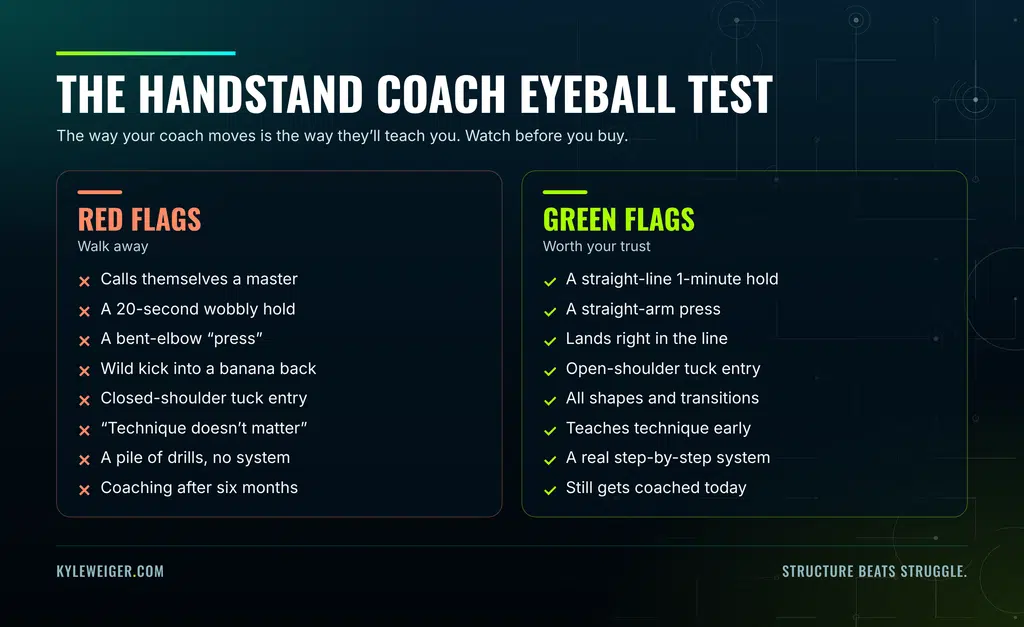
The bent-elbow “press”
Some coaches say they can press to handstand, but then they bend their elbows to get up. That’s a red flag. A real press happens with straight arms, and if they can’t do it, they can’t teach you to do it either.
The wild kick
Watch how they arrive. Do they kick up wildly with both legs, swing into a banana back, then pull their legs back to find their balance? If they don’t land in the line, they spend several seconds searching for it. And even once they find it, it’s often not very straight.
Here’s the tricky part: in their mind, their handstand is straight. But when an experienced hand balancer looks at it, it’s not even close. If your coach can’t see a banana back in their own handstand, they won’t spot it in yours.
The closed-shoulder tuck
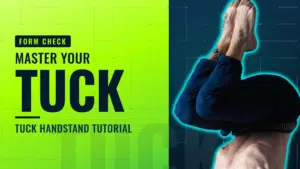
Watch their tuck, too. When they tuck up, do their shoulders dip forward into a closed-shoulder tuck? Or do they jump into an open-shoulder tuck, with their shoulders stacked over their hands? The closed version is a habit, and it’s the one they’ll pass on to you.
Big titles, small handstands
Watch out for anyone who calls themselves a handstand “expert” or “master” but can’t back it up.
Titles are easy. Skill is not. At a minimum, a handstand coach should be able to hold a straight-line handstand for a full minute, with all their shapes, transitions and head positions. In other words, they should have truly mastered the basics they’re teaching you.
If what they have is a wobbly 20-second hold, long enough to make a nice Instagram post, that’s not enough.
A pile of drills, not a system
A lot of these programs don’t actually have a system. What they have is a collection of drills, packaged up and sold in a paid group or a mobile app.
Drills are great. But a stack of drills without a clear order, a progression and a reason behind each step won’t get you very far. A system tells you what to do, when to do it and why.
The biggest trap: “technique doesn’t matter”
This is probably the biggest trap in handstand marketing, so watch for it closely.
In my experience, the coaches who say technique doesn’t matter are usually the ones with shaky technique themselves. If they told you technique was important (which it is, especially for intermediate to advanced skills), you’d give their own handstand the old eyeball test. And it wouldn’t pass.
So instead, they sell you on “just kick up any way you can.” That’s fine for the first couple of months. However, as you get better, you’ll want to move into intermediate and advanced skills.
Here’s the problem. If you practice bad habits too much, too early, you get really good at doing it poorly. Then, when you try a press handstand, shape changes, transitions or one-arm shifts, your whole handstand is built on closed shoulders and a banana back. And now you have to undo all of it.
Look at where they learned
It’s also worth asking who trained your coach. Have they actually been coached by hand balancers? Or have they only done yoga their whole life, or only calisthenics?
I see this one a lot in the calisthenics world. There are plenty of strong athletes who can do impressive tricks like a handstand push-up. But many can’t hold a handstand for endurance, because they don’t have solid technique underneath. As a result, they burn out quickly. All power, no grace.
That’s not a knock on strength. Strength is great. It’s a reminder that a handstand is a balance skill first.
Why I still have a coach
I’ve been training handstands for 15 years and coaching full-time for over 10. I’ve traveled the world teaching seminars in so many countries, and I’ve trained with at least a dozen Cirque du Soleil hand balancers. Along the way, I’ve heard perspectives from yoga teachers, gymnastics coaches, acrobats and hand balancers.
And to this day, I still get coached myself. Why? Because I’m constantly trying to refine. The best coaches never stop being students.
How to choose your next coach
Before you buy a program, run through this quick checklist:
- Watch their entries. Look for straight arms in the press, an open-shoulder tuck, and a kick that lands right in the line.
- Look at their line. Find a straight-line hold of a minute or more, not just a highlight clip.
- Look for a system. There should be a clear progression, not just a pile of drills.
- Listen for technique. Good coaches teach it early, even if they keep it simple.
- Check their lineage. Find out who coached them, and whether they still have a coach today.
For more on this, read my guide on how to choose the right handstand coach.
Learn from a system
If you’re ready to train with a real progression behind every step, The 4 Essential Handstand Elements is where to start. It’s built on technique from day one, so your foundation is solid when you move on to bigger skills. I designed it for adult beginners working at the wall who want a clear path forward.
Keep building with me
If this helped, come train with me on social. I share drills, form checks and coaching breakdowns for adult handstanders at every stage of the roadmap.
- Instagram: @kyleweiger
- TikTok: @handstandcoach
- YouTube: youtube.com/kyleweiger
- Facebook: Kyle Weiger Handstand Coach
Choose your coach like you’d choose your foundation: carefully. You’re on the right path, my friends.
Structure beats struggle.