Kyle Weiger
Share This
Handstand walking through a hand balancer’s eyes
As a hand balancer, I see handstand walking a little differently than most people do.
Other practices, like gymnastics and CrossFit, really embrace handstand walking. They use it for speed, for power or for time. And it’s an excellent strength-building exercise.
I use handstand walking in my own training too, but not in the way you might think. So let’s clear the air on how different athletes use it, and then talk about the kind of walking I actually recommend.
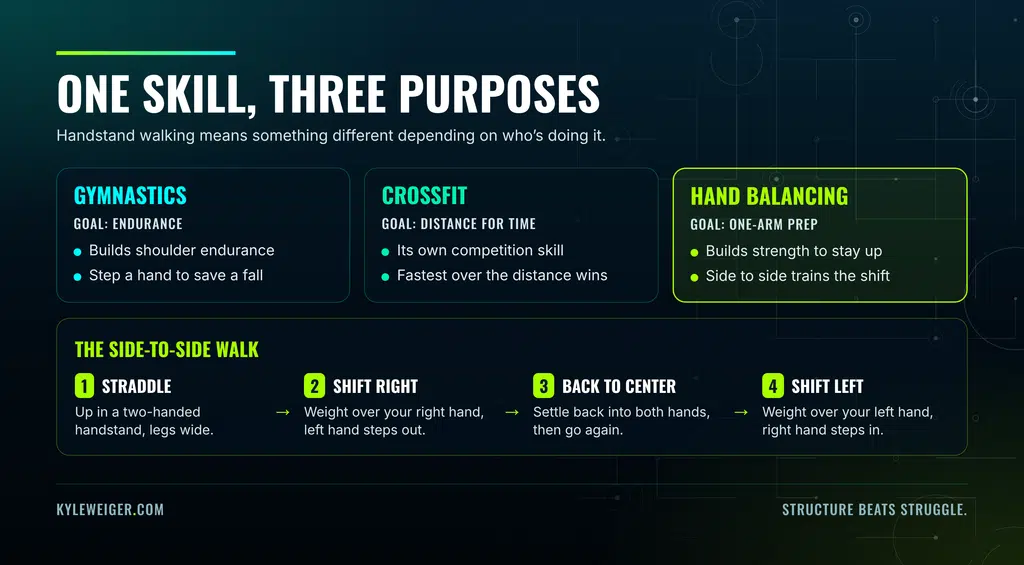
How gymnasts use handstand walking
In gymnastics, handstand walking is a way to develop shoulder endurance. It helps you stay up for longer.
It’s also a save. For example, if you start to fall out of a static handstand, one way to rescue it is to step a hand forward or backward and catch yourself.
How CrossFit uses handstand walking
In CrossFit, handstand walking is its own skill, and there’s even a competition for it. You have to walk a set distance, and whoever covers that distance in the best time is the most proficient.
How hand balancers use it
In hand balancing, the circus art, I use walking a lot like a gymnast would: to build strength. I want to be able to stay up for long periods of time.
However, handstand walking isn’t really a skill you’d show off in a performance. You won’t see it as the big moment in a Cirque du Soleil-level hand balancing act.
My favorite kind of handstand walking: side to side
My favorite form of handstand walking isn’t forward, and it isn’t backward. It’s side to side.
Why? Because side-to-side walking, done correctly, is very similar to one-arm shifting.
Think about how you walk on your feet. You shift all your weight into your right foot, so your left foot can step forward. Then you absorb all that weight into your left foot, so your right foot gets light enough to move.
Side-to-side handstand walking works the same way:
- Straddle. Get up in a two-handed handstand and open your legs into a straddle.
- Shift right. Lean all the way over until your weight sits on top of your right hand. Then your left hand can step out to the left.
- Back to center. Shift back to the middle, onto both hands.
- Shift left. Lean over until your weight sits on your left hand, then step your right hand in.
Your legs tick-tock back and forth like a metronome, on a rhythm. It doesn’t look like the standard handstand walk you’d see at a CrossFit competition or a gymnastics practice. Still, it’s incredibly useful for hand balancers, especially if you want to learn a one-arm handstand.
Where to start: side-to-side walking at the wall
Start at the wall. Get up chest to wall, straddle your legs, and start to tick-tock them like a metronome. Then walk side to side down a long wall, and walk back in the other direction.
Once you take that skill into freestanding, you’re getting very, very close to one-arm shifting. That’s the whole point if you want to approach walking the way a hand balancer does, as a path to skills like the one-arm.
For beginners: the wall walk
If you’re newer to handstands, there’s another form of walking that’s perfect for you: the wall walk.
Start in a plank with your feet at the baseboard. Put one foot up on the wall and crawl a hand in. Next, put the other foot on the wall and crawl another hand in. Keep going until you’ve crawled your body all the way vertical, then crawl yourself all the way back out.
So when should you learn handstand walking?
Handstand walking comes in a lot of different forms, and different athletes use it for different purposes. There’s no single right version.
In my courses here on kyleweiger.com, most of my students are after the handstand skill of shifting from side to side. They’re not training the endurance to walk the length of a basketball court on their hands. So here’s the path I recommend:
- If you’re new, start with wall walks to build strength and comfort upside down.
- Once you can hold a chest to wall straddle, start side-to-side walking at the wall.
- Once your freestanding is consistent, take the side-to-side shift off the wall, and you’re on your way toward one-arm work.
Start at the wall
Wall walks are part of The 4 Essential Handstand Elements, along with the other wall drills that build your foundation. The course walks you through each one step by step. I designed it for adult beginners working at the wall who want a clear path forward.
Keep building with me
If this helped, come train with me on social. I share drills, form checks and coaching breakdowns for adult handstanders at every stage of the roadmap.
- Instagram: @kyleweiger
- TikTok: @handstandcoach
- YouTube: youtube.com/kyleweiger
- Facebook: Kyle Weiger Handstand Coach
Shift, settle, step, repeat. You’re on the right path, my friends.
Structure beats struggle.