
Kyle Weiger
Share This
The chest to wall handstand vs back to wall debate
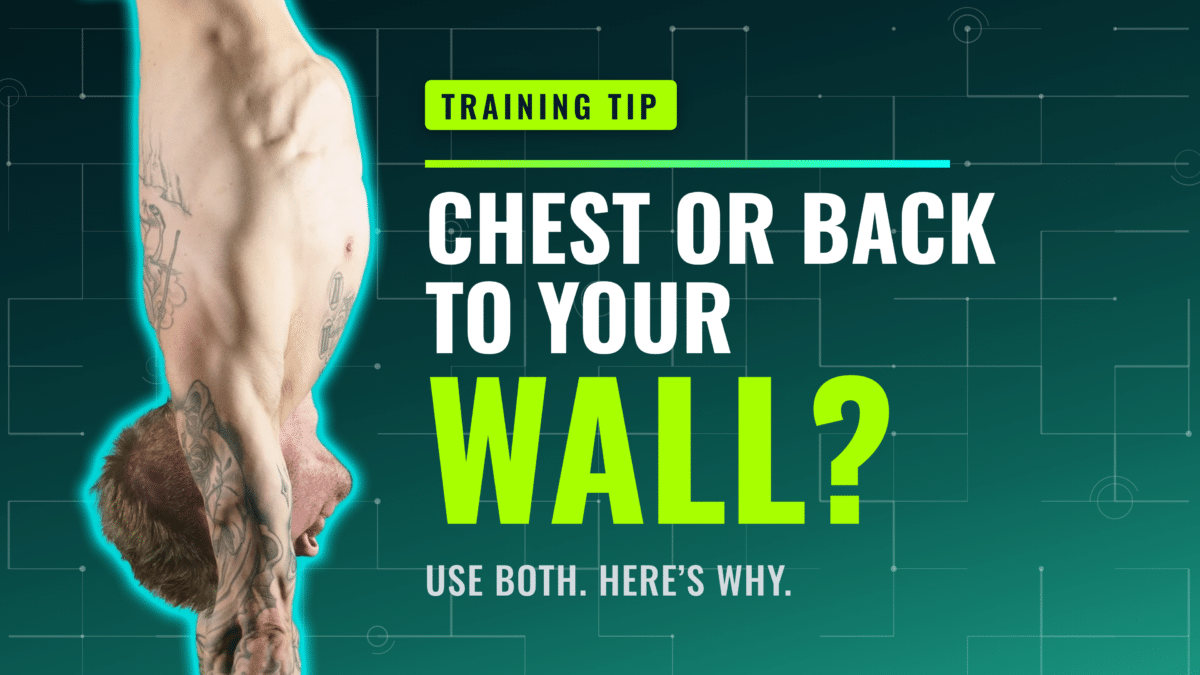
It’s one of the most common questions in handstand training: should you do chest to wall handstand drills or back to wall drills? Which one is better?
Here’s the honest answer: neither one is better. Both have a time and a place in your practice, and you should never only be doing one of them.
Think of your wall like a Swiss Army knife. It’s one tool with lots of different ways to use it. Once you see it that way, the question stops being “which one?” and becomes “which one do I need right now?”
Which ones can you do right now?
If you can kick up to the wall, you have access to both. You can kick up and train back to wall drills, and you can also climb in for chest to wall work.
If you can’t kick up to the wall yet, climbing into the wall is a good place to start. In that case, you wouldn’t go all the way into a full chest to wall handstand, since that’s a little too much at first. Instead, climb partway up and build from there.
What chest to wall does best
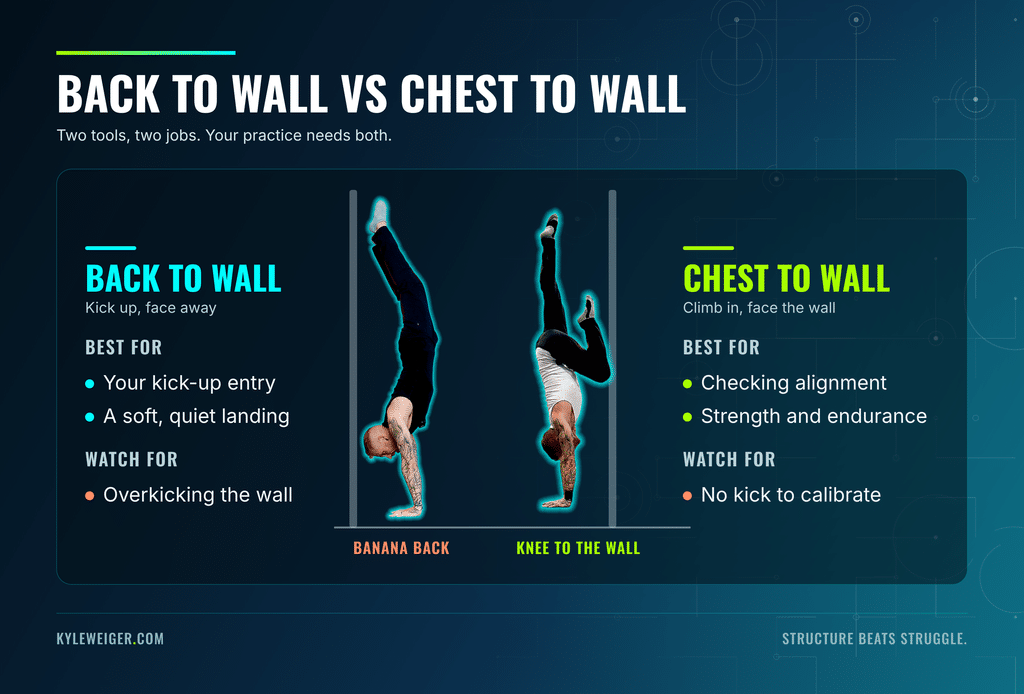
Alignment. The chest to wall handstand is the better drill for alignment. The flat surface of the wall gives you instant feedback, so you can make sure your ribs aren’t flaring and you’re not sliding into the dreaded banana back.
Drills you can’t do any other way. Facing the wall also opens up drills you simply don’t have access to with your back to the wall, like shape work and posterior pelvic tilt drills.
Strength. Chest to wall is also where a lot of great strength work lives. Wall walks and chest to wall endurance holds build the strength your freestanding handstand needs.
What back to wall does best
Back to wall is where you practice your entry. Every kick to the wall is a chance to work on how you get upside down, not just whether you get there.
So use those reps to soften your kick. Be graceful, and pay attention to where and how you land. Calibration drills like twinkle toes, toe floats and heel pulls are perfect here, because they teach you to arrive softly instead of crashing in.
The downside of using only one
Here’s why you need both: each one has a blind spot that the other one covers.
Only back to wall: the kick to the wall often produces an overkick. If that’s all you ever do, you can build the habit of overkicking, and that habit follows you into the middle of the room.
Only chest to wall: you have to climb into the entry. As a result, you never actually get to work on calibrating your kick.
So the answer is both. Back to wall trains your entry, while chest to wall trains your alignment and strength. Together, they cover each other’s gaps.
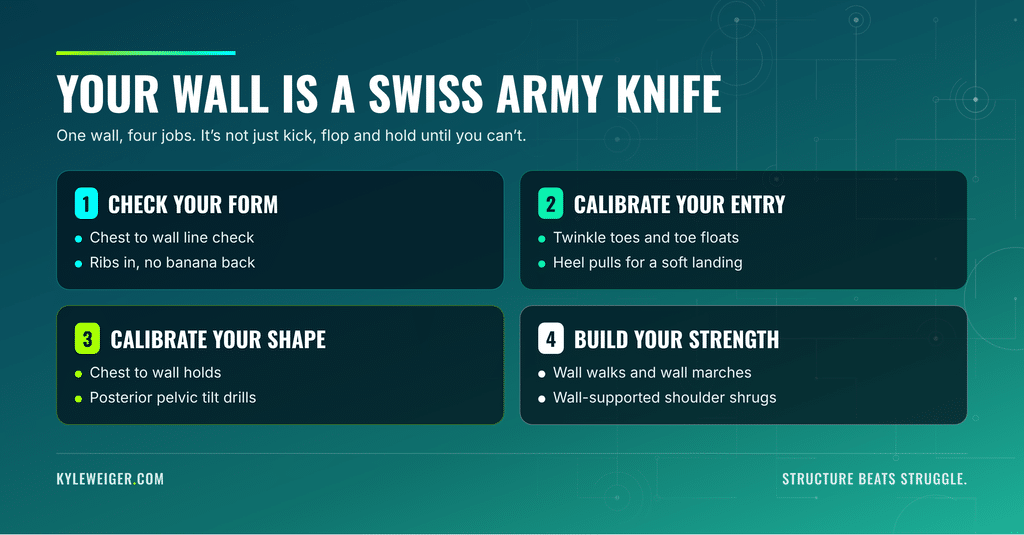
Your wall is a Swiss Army knife
A lot of people use the wall exactly one way: kick, flop against it, then hold until they can’t hold anymore. That’s like using a Swiss Army knife as a doorstop.
Instead, use your wall for whatever your practice needs right now:
- Check your form. Use the flat surface of the wall to check your line, keep your ribs in and avoid a banana back.
- Calibrate your entry. Use your kicks to the wall to practice a soft, graceful entry with twinkle toes, toe floats and heel pulls.
- Calibrate your shape. Chest to wall holds and posterior pelvic tilt drills help you dial in your shape.
- Build your strength. Wall-supported shoulder shrugs, wall marches and side-to-side wall walks all make you stronger.
Avoid the one-way mindset
The pitfall a lot of students fall into is thinking there’s only one way to approach the wall. That’s a very narrow mindset, and it slows your progress.
Here at kyleweiger.com, the handstand training method is built on adaptability. If you want to get good, you have to be adaptable. That means picking the right tool for the job, then switching tools when your practice needs something different.
Try this in your next session
Use your wall three different ways:
- Calibrate. Start with a few soft back to wall kicks, focusing on a quiet landing.
- Align. Next, climb into a chest to wall hold and check your line: ribs in, no banana back.
- Strengthen. Finish with one strength move, like wall walks or wall-supported shoulder shrugs.
Three jobs, one wall. That’s how you get the most out of it.
Learn all of these wall drills
These wall drills, from twinkle toes and heel pulls to wall walks and chest to wall endurance holds, are part of The 4 Essential Handstand Elements. The course shows you when and how to use each one, so you always know which tool you need. I designed it for adult beginners working at the wall who want a clear path forward.
Keep building with me
If this helped, come train with me on social. I share drills, form checks and coaching breakdowns for adult handstanders at every stage of the roadmap.
- Instagram: @kyleweiger
- TikTok: @handstandcoach
- YouTube: youtube.com/kyleweiger
- Facebook: Kyle Weiger Handstand Coach
Use every tool in the knife. You’re on the right path, my friends.
Structure beats struggle.