
Kyle Weiger
Share This
Why your handstand training schedule needs structure and play
I plan out my handstand training schedule for almost every day of the week. Almost.
However, one day a week, there’s no plan at all. Instead, I grab my gym bag, show up, throw the headphones in, and it’s time to party.
At first, that might sound like it goes against everything I teach. In fact, it doesn’t. Foundations are everything in handstand, and foundations come from structure. But structure is what makes the play day possible, and the play day is a big part of what keeps you coming back to train.
So here’s how the balance works, and how you can build it into your own week.
Rest days are part of your structure
Before we get into training days, I need to say this clearly: rest days are part of your structure. In fact, I cannot stress that enough.
I structure six days of my week. Some of those days are training days, while others are rest days. Both count, because I plan both.
And a rest day from handstand doesn’t mean you only do a few handstands. Instead, it means you do zero handstands. That means no kicking up to the wall, no quick hold in the kitchen, and no weight on your hands or wrists at all.
Your wrists and shoulders do a ton of work in this practice. That’s why the rest day matters: it’s when they recover, so the next training day can actually be productive. In other words, skipping rest isn’t extra credit. It just borrows from your next session.
What a structured training day looks like
Three days a week, I follow a structured program. Right now, for example, my focus is two hard skills: a one-arm handstand and the stalder press.
On those days, nothing is random. Instead, I know:
- Which drills I’m doing, and in what order
- How many sets and reps of each exercise
- My target hold time for every drill
- Which parts are strength and which parts are technique
I don’t walk in and decide based on how I feel. Instead, I’ve already made the plan, so all my energy goes into doing the work well. That’s what structure buys you: you stop wasting effort on guessing and put it all into getting better.
Why I schedule a day of play
Then, after those structured days, comes a day of play. It’s completely free. No drill list, no hold times, no sets and reps. Instead, I work on choreography and shape changes, and I let myself move more freely.
Here’s the funny part: yes, I schedule my play. The day itself has no structure, but it has a protected spot in my week. Otherwise, if I left play up to chance, “one more training day” would squeeze it out.
Play isn’t a reward for finishing the real work. Instead, it’s part of the work. It’s where you get to enjoy the skills you’ve been building, try things without pressure, and remember why you started doing handstands in the first place. After all, hard training only lasts if you still love doing it.
The same balance, in every session
This isn’t just how I plan my own week. In fact, it’s how I coach everywhere, just at different sizes.
- In my courses: in The 8 Week Freestanding Protocol, every workout follows a clear structure. Then each one ends with 5 minutes of open floor playtime, so you can kick up in the middle of the room and have a good time.
- In my live classes here in Vegas: same idea. The structured work comes first, then we finish with open floor.
- At my workshops: in a 3-hour workshop, we spend the first two and a half hours following the order, the system, the progressions, and the acquire, refine, maintain method. After that, the end is open forum.
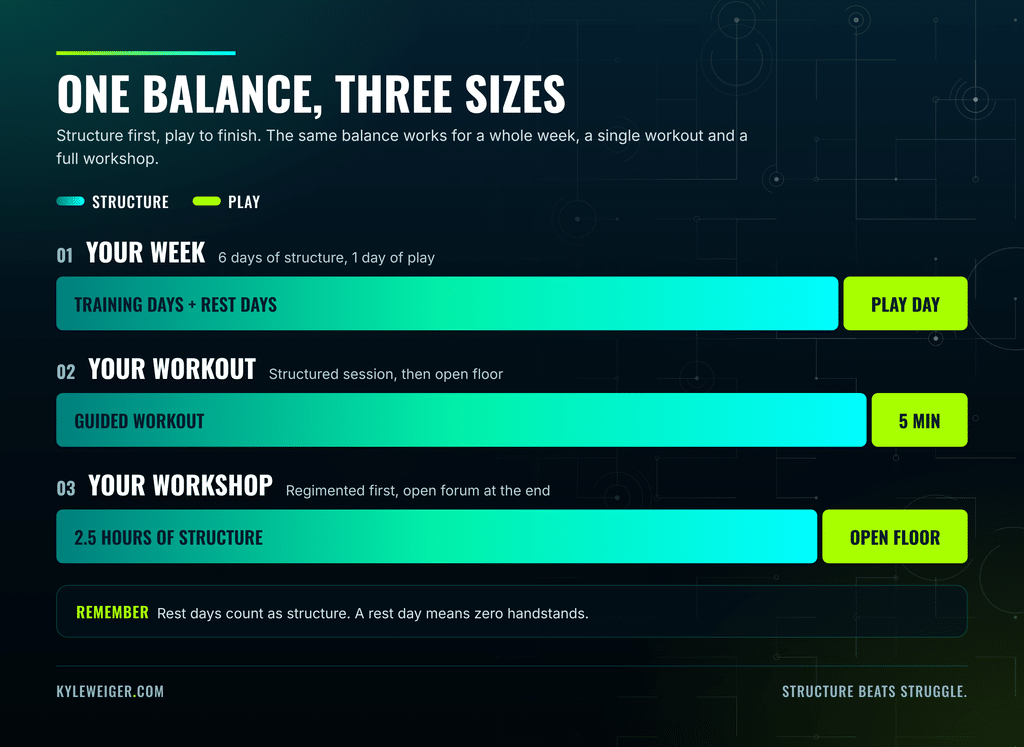
At the end of every workshop, I tell people the same thing. I want you to leave with something that makes you happy. Something that brings you joy. The structure is what gets you better. The joy is what brings you back.
How to build your handstand training schedule this week
You don’t need my exact week. You need the same balance. Here’s how to set up your own handstand training schedule:
- Pick your training days. Three structured sessions a week is a great place to start. Put them in your calendar like any other appointment.
- Plan each session before you show up. Drills, order, hold times, sets and reps. If you’re deciding what to do once you’re already on the floor, it’s not a plan yet.
- Protect your rest days. Zero handstands. Not a few, zero.
- Schedule one day of play. No plan for the day itself, just a spot in your week that belongs to it.
- End each session with 5 minutes of open floor. This is the whole balance in miniature, and it’s the easiest way to start.
If you’d rather not build all of this yourself, that’s exactly what The 8 Week Freestanding Protocol does for you. Every workout is fully guided and structured, and every one finishes with open floor playtime. It’s built for people who can kick to the wall with no problem and have caught a few seconds freestanding, and want those seconds to show up consistently.
Keep building with me
If this helped, come train with me on social. I share drills, form checks and coaching breakdowns for adult handstanders at every stage of the roadmap.
- Instagram: @kyleweiger
- TikTok: @handstandcoach
- YouTube: youtube.com/kyleweiger
- Facebook: Kyle Weiger Handstand Coach
Plan the work, protect the rest, and save a little room for play. You’re on the right path, my friends.
Structure beats struggle.