
Kyle Weiger
Share This
Why handstand basics come first
A lot of people skip the handstand basics and go straight for the big skills. The press. The shape changes. The one-arm handstand.
I love the ambition. But here’s where everyone gets it backwards: they want the one-arm before they have a 10-second hold on two hands.
Big skills aren’t a separate thing you go learn later. They’re what your handstand basics turn into after you’ve built them long enough. If you take the shortcut, the path is actually longer.
So let’s talk about how to build a handstand in the right order, and why the boring stuff is what gets you to the fun stuff.
Build your handstand like a house
Think about how a house gets built. You pour the concrete foundation first. Then you build the frame. Then come the walls, the electrical, the plumbing and the light fixtures. Decorating happens much, much later.
You don’t pick out the color of your cabinets while the concrete is still wet. But that’s exactly how a lot of people treat their handstand.
Here’s how the same order looks upside down:
- The foundation: a controlled kick to the wall, wall holds, and strong, resilient wrists and shoulders.
- The frame: balance with the wall, then balance without it. This is where your straight line gets built.
- The walls and wiring: freestanding endurance. Holds you can count on, not holds you hope for.
- The decor: the press, shape changes, head positions and the one-arm.
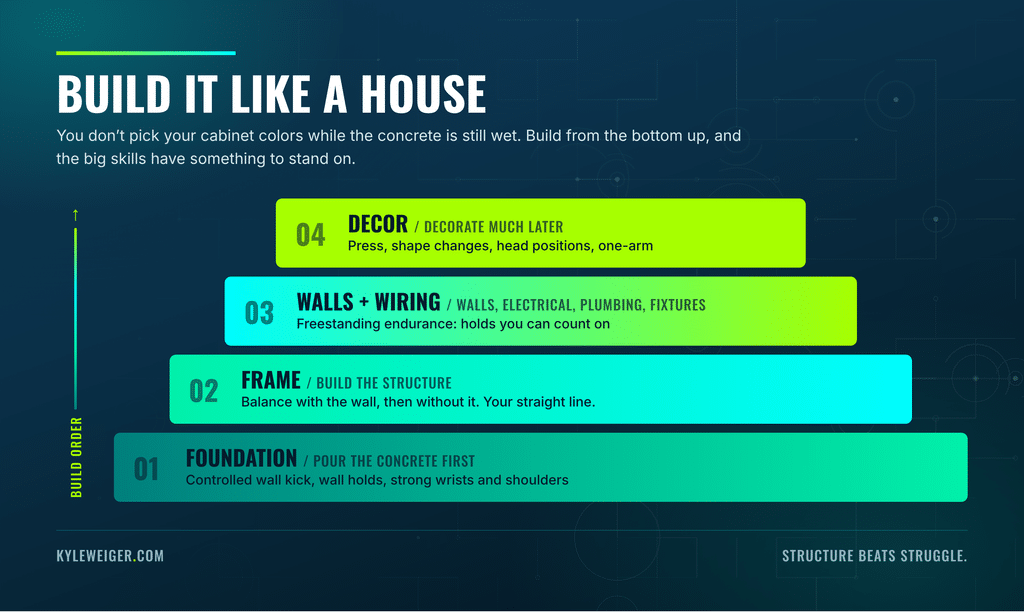
The decor is the fun part. It’s also the first thing to fall apart when the foundation underneath it isn’t ready. Don’t decorate your house before the foundation is built.
Your handstand roadmap: five stages, in order
Every handstand I coach moves through the same five stages. Each one builds on the one before it.
- Controlled Wall Kick. The same smooth entry every time, no slamming into the wall.
- Balance With The Wall. Using the wall as a tool and not a crutch. One leg off, then the other, then both.
- Balance Without The Wall. Your first real freestanding seconds in the middle of the room.
- Freestanding Endurance. Turning a few lucky seconds into holds you can hit on command.
- Press, Shape Changes and Advanced Skills. The big stuff everybody wants.
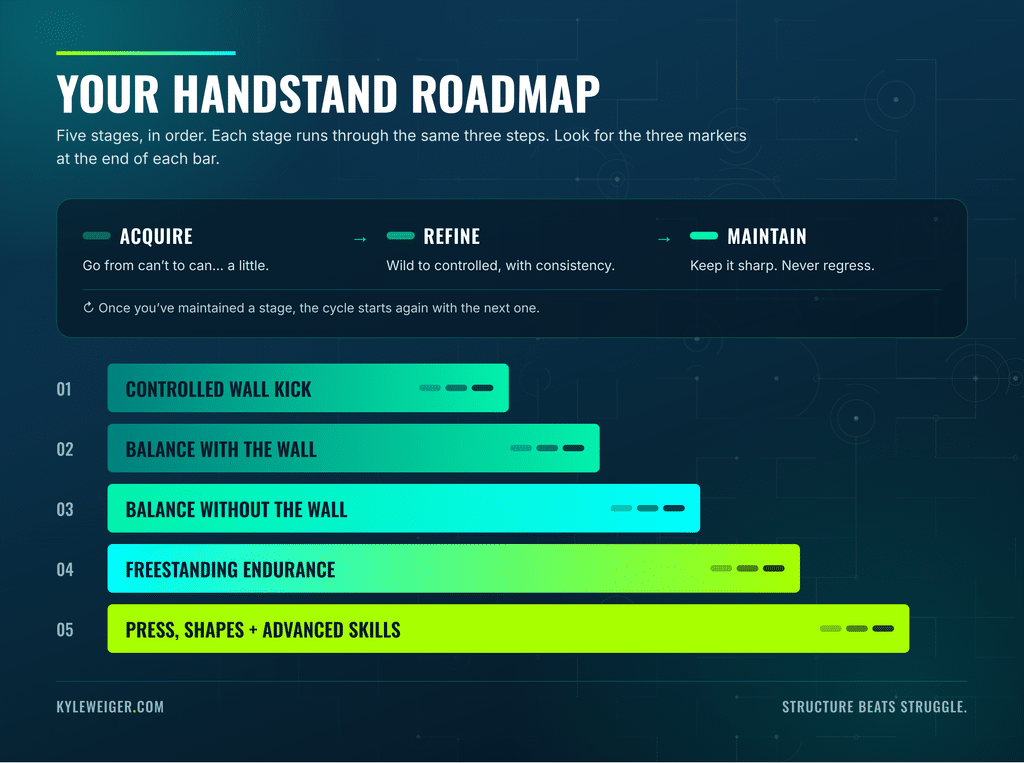
Notice where the press and the one-arm live. Stage five, at the very end of the line. You don’t get there by skipping ahead. You get there by building your handstand basics in the four stages underneath it.
Acquire, Refine, Maintain: the cycle inside every stage
Each of those five stages runs through the same three steps. Look for the three markers at the end of each bar in the roadmap.
- Acquire the skill. You go from can’t to can… a little. It feels awkward and slow, and progress is hard to see. Show up and trust the process.
- Refine the skill. You go from wild to controlled, with consistency. This is where you get obsessive about the details: your entry, your shape, your hold.
- Maintain the skill. You keep it sharp and never regress. Maintaining a skill takes about half the volume it took to get it in the first place. It just becomes part of your routine.
Once you’ve maintained a stage, the cycle starts again with the next one. And you don’t need perfection to move on. If you can hit it about 7 or 8 times out of 10, you’re ready.
This is also why a good practice is mostly handstand basics. Roughly 80% of your session goes to refining and maintaining what you have. About 20% goes to the hard new thing. New skills get introduced in the same sessions where older ones are being cleaned up, like an assembly line.
Your current goals become your warm-up. That’s what progress actually looks like.
Buy your shoulders, get your legs for free
I say this at every workshop: it’s a BOGO, baby. Buy your shoulders, get your legs for free.
When people want shape changes, they think about their legs. The straddle, the tuck, the scissor. But the legs are the distraction. The shoulder is doing all the work. If your shoulders can’t hold a stacked line overhead, your legs have nothing stable to move from.
The catch is that you have to pay for your shoulders first. That means time in straight-line holds, building endurance and stability before you go play with shapes.
I learned this the honest way. My first hand balancing coach had me conditioning straight-line holds, over and over. I didn’t even realize how valuable it was at the time. Later, when I started working on shapes, they came much more naturally. The base was already paid for.
How to train your handstand basics this week
Find your stage on the roadmap. Then ask yourself one honest question: can I hit this 7 or 8 times out of 10, on a normal day? Not your best day. A normal one.
If the answer is no, you’re still acquiring or refining that stage. That’s your training right now, and that’s good news. It means you know exactly what to work on.
- At the wall: spend your sessions on wall holds for shape. Arms by your ears, ribs down, one straight line. Track your total time in the handstand, not just your best single hold.
- Freestanding: raise your floor. Pick a baseline you can hit even on a tired day, like three reps of a 10-second hold, and build on that before chasing a new max.
Not sure which stage you’re on? [Find your starting point] (internal link to your courses page)
Keep most of every session on the fundamentals and save a small slice at the end for the big skill you’re excited about. The point of the drill is to do the drill. Do it well, do it often, and the big skills will come.
Take the skill cycle with you
Want a quick reference for your training? Download The 3 Stages of Skill Development, a one-page digital guide that breaks down acquire, refine and maintain, and exactly what to focus on in each stage.
Keep building with me
If this helped, come train with me on social. I share drills, form checks and coaching breakdowns for adult handstanders at every stage of the roadmap.
- Instagram: @kyleweiger
- TikTok: @handstandcoach
- YouTube: youtube.com/kyleweiger
- Facebook: Kyle Weiger Handstand Coach
Build the foundation first. You’re on the right path, my friends.
Structure beats struggle.