
Kyle Weiger
Share This
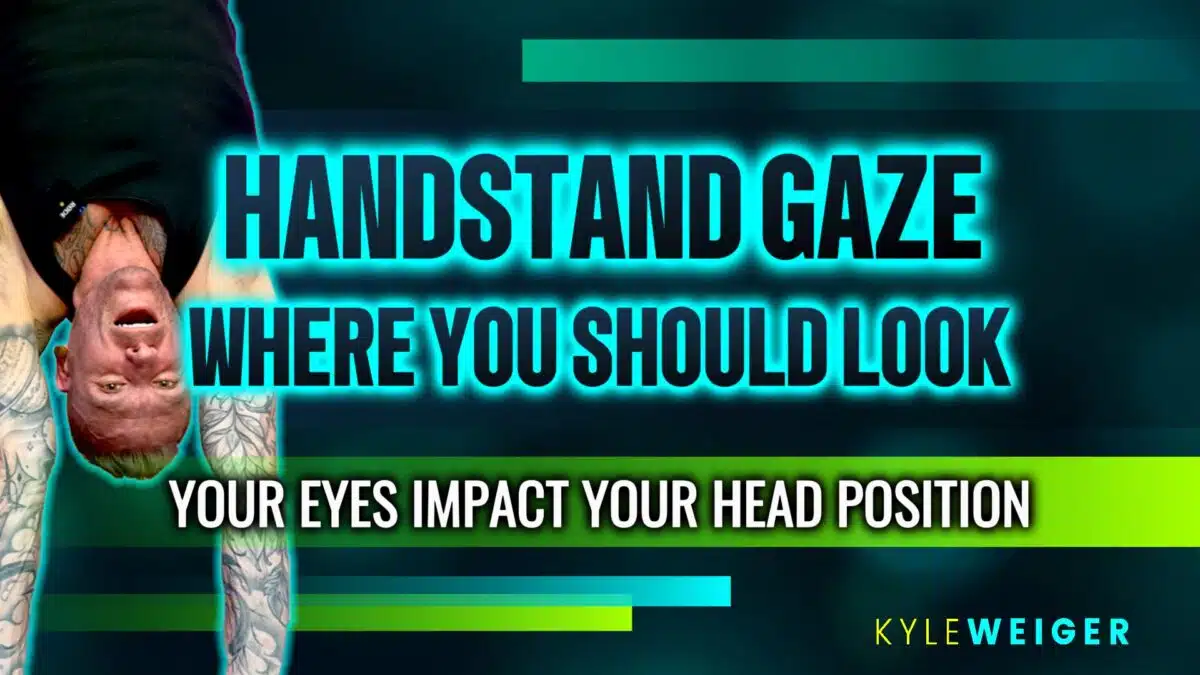
Where You Should Look in a Handstand (And Why Most People Get This Wrong)
“Where should I be looking in a handstand?”
It’s one of the first questions new handstand students ask, and for good reason—your gaze dramatically affects your balance, alignment, and how quickly you progress. In fact, knowing exactly where to look in a handstand can help you advance faster and safer.
Here’s my professional take: Don’t look out ahead past your fingers.
Look Down Between Your Thumbs
Your gaze should be directed down, focused on the space between your thumbs.
Why? Because that’s the direction of gravity, and that vector should guide your decision about where to look when doing a handstand.
The vector of gravity never changes—it’s always pulling straight down toward the earth. In a handstand, we’re trying to align every piece of our body with that vector: our bones, our core, our shoulders, and yes, our vision.
When your eyes are looking down at the ground between your hands, you’re reinforcing proper alignment. Your head stays neutral, your cervical spine doesn’t hyperextend, and your entire kinetic chain can stack efficiently.
The Visual Anchor Advantage
When you’re new to handstands, balance is significantly easier when you have a visual anchor point on the ground. Consequently, where to look in a handstand matters for both stability and confidence.
Think of it like looking at the horizon when you’re trying not to get seasick. That fixed reference point helps your brain process spatial information and make the micro-adjustments needed to stay balanced.
Looking down between your thumbs gives you that anchor. It’s a consistent, unchanging reference point that helps you feel where vertical actually is.
The Advanced Shift: From Vision to Feel
As you get more advanced, something interesting happens: you rely progressively more on proprioception (feel) and less on vision. For those mastering handstands, understanding where to look provides a foundation before transitioning to feel.
Elite handbalancers can hold rock-solid handstands with their eyes closed. Their nervous system has developed such refined awareness of position and pressure that vision becomes almost optional.
But here’s the key—you build that proprioceptive awareness faster when you start with proper visual habits. Looking down between your thumbs trains both your visual and kinesthetic systems simultaneously.
What Happens When You Look Forward
When students don’t know where to look in a handstand, a few things can go wrong:
- The head tilts back, hyperextending the neck
- The spine follows, creating a banana-back shape
- Shoulder alignment suffers as the body compensates
- Balance becomes harder because you’ve lost your stable reference point
You might feel like looking forward gives you better orientation to the room, but you’re actually making balance harder and reinforcing poor alignment patterns. Learning exactly where to look in a handstand will make maintaining balance much easier.
The Bottom Line
Gravity isn’t negotiable. It’s always pulling straight down, and your handstand will be most efficient when everything—including your gaze—aligns with that force. Properly choosing where to look in a handstand ensures you stack your body and maximize control.
Look down between your thumbs. Use that visual anchor while you’re building skill. Trust that as you advance, your reliance on vision will naturally decrease as your proprioceptive awareness grows.
Your neck, your spine, and your balance will thank you.
Want to learn more systematic handstand technique that actually works? Join my free video series on the 21 foundational habits that make handstands click – GET IT HERE!