Kyle Weiger
Share This
Why your handstand workout needs a plan
We’ve all had that session. You kick up, wobble, check your phone, kick up again, try the one-arm you saw on Instagram, and 45 minutes later you honestly couldn’t say what you trained.
That’s not a handstand workout. That’s handstand roulette.
Here’s the fix: structure equals results. In this 60-minute handstand workout, every single minute has a job. It’s broken into four blocks, and each one builds on the one before it:
- Wrist prep and mobility: 10 minutes
- Wall entries and timed holds: 15 minutes
- Skill drills at the wall: 15 minutes
- Freestanding attempts: 15 to 20 minutes
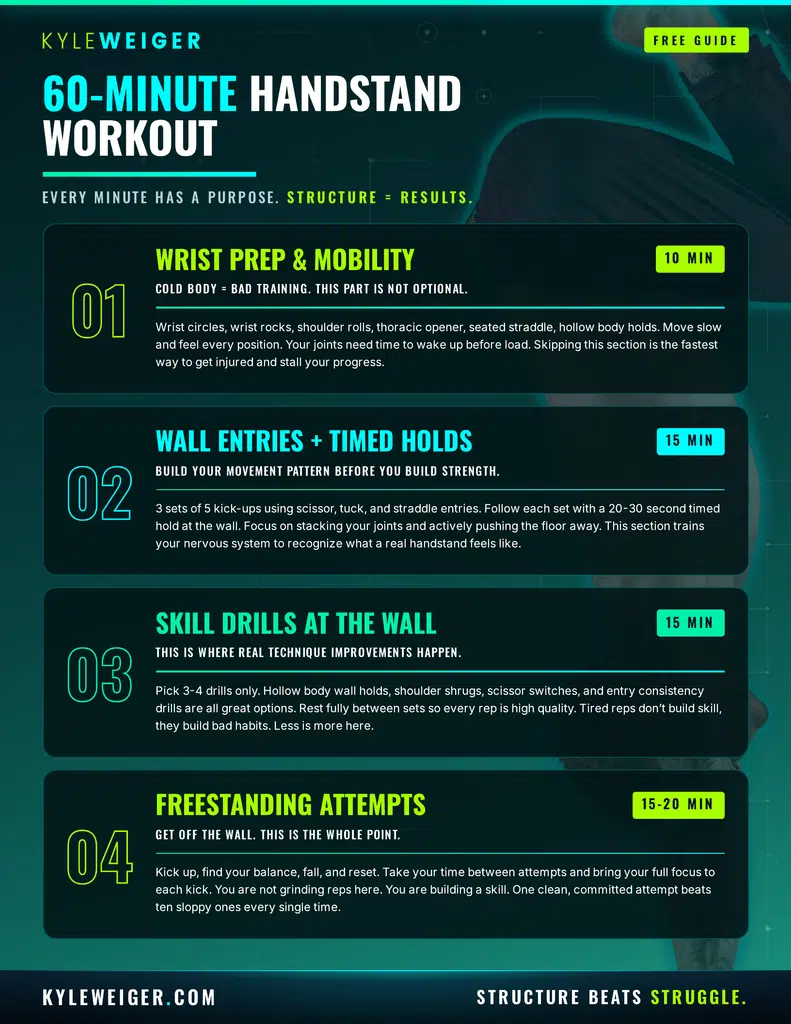
Let’s walk through each block, and why it earns its spot.
Block 1: Wrist prep and mobility (10 minutes)
Cold body equals bad training. This part is not optional.
Start with wrist circles, wrist rocks, shoulder rolls, a thoracic opener, a seated straddle and hollow body holds. Move slowly, and actually feel every position. Your joints need time to wake up before you load them.
Think about it from your wrists’ point of view. They spend all day typing and holding coffee. Then, with zero warning, you ask them to carry your entire body weight. That’s a lot to spring on anybody.
This is the same idea as my big four warm-up: wrists, shoulders, hips and hamstrings, every single time. Your wrists and shoulders matter most, because an injury to either one stops your practice completely. In fact, skipping this block is the fastest way to get hurt and stall your progress.
So give it the full 10 minutes. Future you will be grateful.
Block 2: Wall entries and timed holds (15 minutes)
Here’s the rule for this block: build your movement pattern before you build your strength.
Do 3 sets of 5 kick-ups, using three different entries: scissor, tuck and straddle. Then, after each set, hold a handstand at the wall for 20 to 30 seconds.
While you’re up there, focus on two things:
- Stack your joints. Hands, shoulders and hips in one line.
- Actively push the floor away. No sinking into your shoulders.
This block trains your nervous system to recognize what a real handstand feels like. The more often you arrive in a good shape, the faster your body learns to find it on its own.
Also, pay attention to how you land. If your heels hit the wall like you’re knocking on a door, soften it. Use these entries to calibrate your kick, so you arrive quietly instead of crashing in. Remember, the wall is a tool, not a crash pad.
Block 3: Skill drills at the wall (15 minutes)
This is where the real technique improvements happen.
Pick three or four drills only. A few great options:
- Hollow body wall holds
- Shoulder shrugs
- Scissor switches
- Entry consistency drills
Then rest fully between sets, so every rep is high quality.
I know it’s tempting to cram in ten drills because they all look useful. Don’t. Tired reps don’t build skill, they build bad habits. Your body learns whatever you repeat, including the sloppy version. So here, less really is more.
Block 4: Freestanding attempts (15 to 20 minutes)
Get off the wall. This is the whole point.
Kick up, find your balance, fall, and reset. Then do it again. Take your time between attempts, and bring your full focus to every single kick.
You’re not grinding out reps here. You’re building a skill. One clean, committed attempt beats ten sloppy ones every single time.
And yes, you’re going to fall. A lot. That’s not failure, that’s the price of admission. Every fall teaches your body something, as long as you reset, breathe and make the next attempt count.
How to fit this into your week
This full 60-minute handstand workout works best two or three times a week, with real rest days in between. Your wrists and shoulders need that recovery time to adapt.
Short on time? Shrink the session, not the warm-up. For a 30 to 40 minute practice, keep 8 to 12 minutes of prep, then split the rest between the wall and freestanding.
Download the free 60-minute handstand workout guide
Want the whole plan on hand while you train? Download the free digital guide. All four blocks, the timing and the key cues fit on a single page.
And if you want a full program that structures every session for you, The 8 Week Freestanding Protocol builds on exactly this kind of balance between wall work and freestanding practice.
Keep building with me
If this helped, come train with me on social. I share drills, form checks and coaching breakdowns for adult handstanders at every stage of the roadmap.
- Instagram: @kyleweiger
- TikTok: @handstandcoach
- YouTube: youtube.com/kyleweiger
- Facebook: Kyle Weiger Handstand Coach
Every minute has a purpose. Make yours count. You’re on the right path, my friends.
Structure beats struggle.