
Kyle Weiger
Share This
The Fastest Way To Learn Handstand Isn’t Yoga Classes
Let me be direct: if your primary goal is to learn a solid, controlled handstand, yoga classes are not the fastest path to get there.
I know this might be controversial. Yoga is wonderful for many things. It builds flexibility, body awareness, breath control, and mindfulness. Many yoga practitioners have beautiful handstand practices.
But here’s the reality I’ve observed after a decade of coaching: students who come from a yoga-only background typically take significantly longer to achieve consistent freestanding handstands than students following handstand-specific programming.
This isn’t because yoga teachers are bad or yoga students aren’t dedicated. It’s because yoga classes optimize for something different than systematic handstand skill development.
Let me explain why, and what actually works faster.
What Yoga Classes Do Really Well
Before I explain the limitations, let’s acknowledge what yoga does exceptionally well:
Yoga builds general body awareness. The practice of moving mindfully through poses and paying attention to alignment creates proprioceptive skills that absolutely transfer to handstands.
Yoga develops flexibility. The shoulder and hip mobility you gain from a consistent yoga practice supports handstand training by giving you access to better positions.
Yoga teaches breath control. Learning to breathe calmly in challenging positions is directly applicable to staying relaxed enough to balance in a handstand.
Yoga creates consistency. Many yoga practitioners have regular practice habits, which is essential for any skill development.
These are all valuable. But they’re general qualities, not handstand-specific training.
Why Yoga Classes Fall Short for Handstand Development
Here’s where the problems start:
Problem #1: Handstands Get 5-10 Minutes in a 60-Minute Class
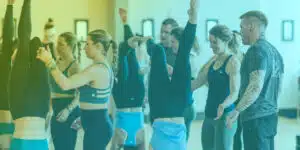
In a typical yoga class, handstands might show up for a few minutes. Maybe the teacher cues “hop to handstand” or “kick up if you’d like.” Maybe there’s a brief wall handstand hold.
Then the class moves on to the next pose.
You’re getting 5-10 minutes of handstand exposure in an hour-long class. The rest of the time is spent on forward folds, warriors, binds, backbends, and everything else yoga encompasses.
Compare this to a dedicated handstand session where you spend 30-40 minutes working specifically on the strength, alignment, and balance components that create handstands.
The yoga student is getting 5-10 minutes of relevant practice 3 times per week (15-30 minutes total). The dedicated handstand student is getting 90-120 minutes per week of focused, progressive practice.
Over months, this difference compounds massively.
Problem #2: Minimal Progressive Structure
Yoga classes are designed to be accessible to students at multiple levels practicing in the same room. The teacher has to cue for everyone from absolute beginners to advanced practitioners.
This means handstand instruction is often vague and non-progressive:
“Kick up to handstand if you’d like.” (No instruction on proper entry mechanics). “Hold at the wall.” (No guidance on alignment, shoulder position, or how to use the wall correctly). “Play with your handstand.” (No specific drills, no clear progression, no benchmarks).
There’s rarely a systematic progression from week to week. No clear path from “I can barely kick up” to “I can hold 30 seconds freestanding.” Just intermittent exposure without structure.
Handstand skill requires progressive overload. You need to build strength systematically, refine technique incrementally, and challenge your balance in measurable ways. Yoga classes rarely provide this for handstands.
Problem #3: No Individualized Feedback
In a class of 15-30 people, the teacher can’t give detailed individual feedback on your handstand technique.
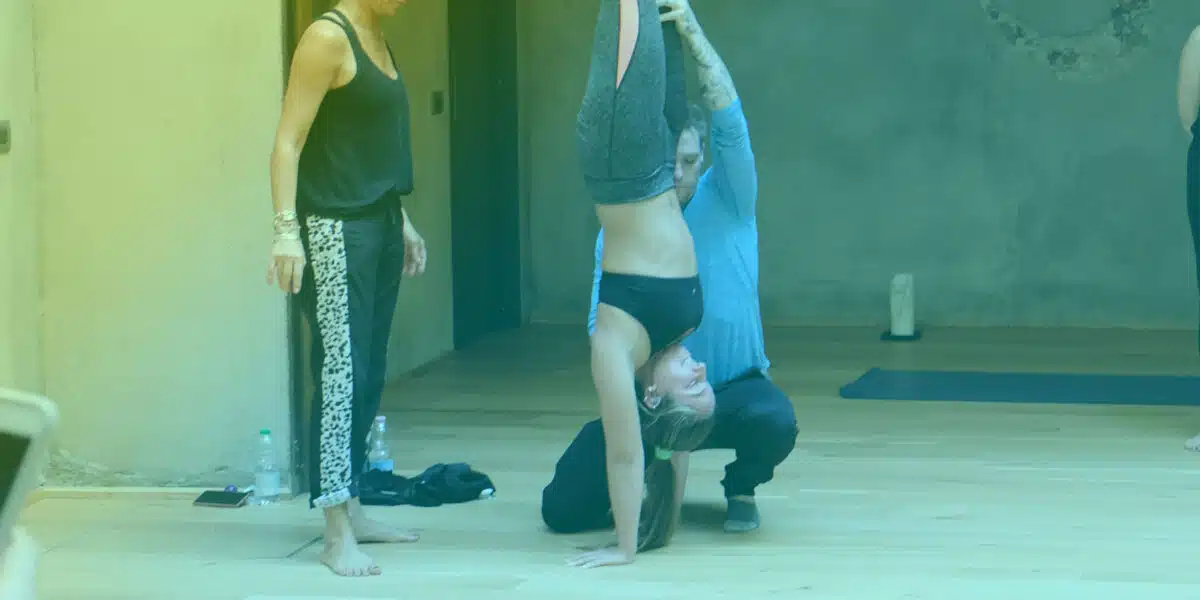
They might walk by and offer a quick adjustment. But they can’t spend 5 minutes analyzing your shoulder position, your entry mechanics, your weight distribution, and giving you specific corrections to work on.
Without detailed feedback, you’re practicing blind. You might be reinforcing a banana back or closed shoulders for months without anyone telling you. By the time you realize it’s a problem, you’ve built deeply ingrained compensation patterns.
Compare this to working with a handstand-specific coach (even online) who can analyze your video, identify exactly what’s limiting your progress, and give you targeted drills to address it.
The difference in progress rate is enormous.
Problem #4: Yoga Prioritizes Flow, Not Strength Development
Yoga is designed around flowing movement, breath synchronization, and holding poses for moderate durations (typically 5-30 seconds for most poses).
Handstands require significant targeted strength work. Especially for beginners, you need to build:
- Wrist conditioning to handle sustained load
- Shoulder stability in overhead positions
- Core anti-extension strength
- Scapular control and endurance
This requires dedicated strength training with progressive resistance. Holding downward dog and chaturanga builds some relevant strength, but it’s not enough or specific enough for rapid handstand development.
Handstand-specific programming includes conditioning work designed precisely for the demands of the skill. Yoga classes rarely include this level of targeted strength development.
Problem #5: The “Just Keep Trying” Approach
The most common handstand instruction in yoga classes is some variation of “just keep practicing, it’ll come with time.”
This sounds encouraging, but it’s not actually helpful guidance.
What should you practice? How should you practice it? What progressions should you follow? What’s the difference between productive practice and just repeating the same mistakes?
These questions don’t get answered in most yoga classes because there isn’t time or structure to address them.
Students end up doing the same wild kick-ups class after class, month after month, hoping that eventually it’ll click. Sometimes it does (after a year or more). Often it doesn’t, and students give up thinking they’re “just not built for handstands.”
What Actually Works Faster: Handstand-Specific Training
If you want to learn handstands efficiently, you need training designed specifically for that goal.
Here’s what that looks like:
Dedicated Session Time
Instead of 5-10 minutes embedded in a yoga class, you spend 45-75 minutes entirely focused on handstand development.
This includes: Proper warm-up specific to handstand demands. Progressive drill work targeting your current limitations. Focused freestanding practice. Targeted conditioning for handstand-relevant strength. Adequate cool-down and recovery work.
More time on task means faster skill acquisition. This is true for any motor skill, handstands included.
Systematic Progression
You’re not randomly trying handstands. You’re following a structured program that builds skill in layers:
1-2 Weeks: Foundation work (wrist conditioning, basic alignment, wall holds). 3-4 Weeks: Building time under tension and shoulder stability. 5-6 Weeks: Controlled entry practice and brief freestanding attempts. 7-8 weeks: Balance refinement and hold time extension.
Each phase builds on the previous one. You have clear benchmarks to know when you’re ready to progress. You’re not guessing.
This is how my 8 Week Freestanding Protocol is designed. Clear progression, specific drills for each phase, measurable outcomes.
Technical Coaching and Feedback
Whether you’re working one-on-one with a coach or following video-based programming with submission for feedback, you get detailed analysis of your technique.
Someone identifies that your shoulders are closed and gives you specific mobility work and cueing to fix it. A coach sees that you’re kicking with too much momentum and teaches you controlled entry mechanics. They notice your ribs are flaring and shows you how to engage your core properly.
This feedback loop accelerates progress dramatically compared to practicing without guidance.
Handstand-Specific Strength Work
Your conditioning work is designed precisely for handstand demands:
Pike pushups that build the exact shoulder strength pattern you need. Hollow body holds that develop the core control handstands require. Scapular work that creates stability in overhead positions. Wrist conditioning protocols that build capacity progressively.
This isn’t general fitness. It’s targeted development of the specific physical qualities that create handstand skill.
Focus on Quality Over Quantity
In dedicated handstand training, you’re not just accumulating attempts. You’re practicing with intention:
Each entry is controlled and purposeful. Your holds focuses on specific technical elements. Each session has clear goals. Rest between sets allows for quality repetitions.
Quality practice creates neural pathways that lead to skill. Random, fatigued attempts create sloppy patterns that have to be unlearned later.
The Timeline Difference
Let me give you realistic timelines based on what I’ve observed coaching thousands of students:
Yoga Class Approach (2-3 Classes Per Week)
Month 1-3: Learning to kick up to the wall, building basic comfort being inverted. Month 4-6: Starting to catch brief moments of freestanding balance (1-2 seconds). Month 7-12: Working toward consistent 5-10 second holds. Month 12-18: Achieving reliable 15-30 second holds.
Timeline to consistent 30-second freestanding hold: 12-18 months
Dedicated Handstand Training (3-4 Sessions Per Week)
Month 1-2: Wall work building strength and alignment, learning controlled entries. Month 2-3: Catching first freestanding balances (2-5 seconds). Month 3-4: Building to consistent 10-15 second holds. Month 4-6: Working toward 30+ second holds.
Timeline to consistent 30-second freestanding hold: 4-6 months
The difference isn’t subtle. It’s 3-4x faster progress with dedicated training.
“But I Love Yoga, Should I Quit?”
Absolutely not. This isn’t about yoga being bad. It’s about being honest about what tools are most efficient for specific goals.
If you love yoga and also want the fastest way to learn handstand efficiently, here’s what to do:
Keep your yoga practice for all the benefits it provides (flexibility, breath work, mindfulness, community). Add 2-3 dedicated handstand sessions per week following structured programming. Use the body awareness and breath control from yoga to enhance your handstand practice. Think of yoga as complementary work, not your primary handstand training.
This combination works beautifully. You get the holistic benefits of yoga plus the targeted progression of handstand-specific training.
What doesn’t work well: Relying solely on yoga classes and expecting rapid handstand progress. You’ll eventually get there, but you’re choosing the slow path.
The Real Question: What Do You Actually Want?
This all comes down to your actual goals.
If you want to enjoy yoga practice and handstands are just a fun bonus that you’ll eventually explore without timeline pressure: Yoga classes are perfect. Keep doing what you’re doing. Enjoy the journey without worrying about optimization.
If you have a specific timeline goal (like achieving a 60-second handstand in the next 6 months): You need dedicated handstand training. Yoga classes won’t get you there in that timeframe.
If you’re frustrated that you’ve been “working on handstands” in yoga classes for a year with minimal progress: It’s not you. It’s the training approach. Switch to handstand-specific programming and watch your progress accelerate.
Be honest with yourself about what you actually want, then choose the training approach that serves that goal.
The Bottom Line: Choose the Right Tool for the Job
Yoga classes are wonderful for many things. Building holistic body awareness. Developing flexibility. Creating mindful movement practice. Cultivating breath control.
But the fastest way to learn handstands is handstand-specific training with progressive structure, adequate volume, technical coaching, and targeted strength development.
If handstands are genuinely a priority goal for you, treat them like a priority. Dedicate focused time and follow systematic programming designed specifically for handstand skill acquisition.
You can still do yoga. But don’t expect yoga classes to be your primary handstand training vehicle if you want efficient progress.
Choose the right tool for the job you’re trying to accomplish.
Ready to Actually Learn Handstands Efficiently?
If you want structured, progressive handstand training that gets you from wall work to consistent freestanding holds in months (not years), I’ve built systems specifically for this.
[The 4 Essential Elements course] provides comprehensive handstand training specifically for beginners with systematic progression.
[The 8 Week Freestanding Protocol] is designed to take you from wall-dependent to freestanding in 8 focused weeks with clear daily programming.
Both include the structure, technical coaching, and progressive overload that yoga classes can’t provide.
These habits include the training principles and practice strategies that create efficient progress.
Love yoga for what it is. But if you want handstands, train for handstands.
PS: Follow me on socials: Instagram, Facebook, TikTok, Reddit