
Kyle Weiger
Share This
You were once terrible at one job
Every handstand skill you’ll ever learn follows a story you’ve already lived once.
There was a time in your life when you had exactly one job, and you were terrible at it.
You didn’t have to go to work or earn money. Nobody expected you to feed yourself, change yourself or bathe yourself. Other people took care of all of that. Your whole brain had one focus.
You’d look around with your big eyes and see everyone else doing this one thing. So you’d try it. And no matter how many times you tried, it just wasn’t coming together.
That thing was walking. For a year or more, you were awful at it. Unskilled, clumsy and completely uncoordinated.
Then, slowly, your mind and body started connecting. First you could grab a piece of furniture, or your dad’s leg, and pull yourself up to stand. One step closer, but still a long road. Next you’d stand with a hand on the couch, take a step and fall down. Everyone cheered anyway, because it was your first step. Then a few steps, then a fall. Then a few more.
And then one day, it all came together. You could walk.
Why handstands feel so slow
Adults expect handstand to be fast. They forget they ever went through this, because nobody remembers being 12 months old.
But that’s exactly the process you’re in now. A handstand is a new motor skill, and new motor skills are hard to learn. Your body needs a lot of tries before the pieces connect. (If you’re wondering how long that takes, read How Long Does It Take To Learn A Handstand?)
Here’s the part I want you to hold onto: handstands are hard to learn, but once you have them, they’re easy to keep.
The cold skill: why you never forgot how to walk
Why haven’t you forgotten how to walk? Because you walk every single day. You get out of bed and go. You don’t even think about it.
Walking is what I call a cold skill. A cold skill is something you can do without thinking and without a warm-up. You probably have more of them than you realize:
- Walking
- Typing on a keyboard or your phone
- Using your phone
- Tying your shoes
- Riding a bike
- Signing your name
You don’t consciously think through any of these. They just happen.
A handstand can become a cold skill too. Mine is. I almost never handstand cold, because I always warm up my wrists first. That’s just a good idea for joint longevity. (Here’s the warm-up I use.) But if I absolutely had to kick up right now with no warm-up, I could. I’ve done it so often, for so long, that it’s simply there.
How a handstand skill becomes easy mode
So how do you turn your handstand into a cold skill? Volume, frequency and consistency.
I’ve said it before, and I’ll say it again: there will never be a substitute for high-quality reps done frequently over long periods of time. That’s how you get good at any skill, and handstand is no exception.
That first part, the hard-to-learn part, is where most people quit. They don’t like the learning curve. What they don’t see is what waits on the other side of it: maintenance.
Once you have your handstand, keeping it is the easy part. Just like walking, as long as you handstand a couple of times a week, the skill stays sharp and fresh. Regression only shows up when you quit altogether or take really long breaks.
Astronauts are a great example. On the International Space Station, they float around for months and barely use their legs. When they come home, many of them need time to get their legs working again before walking feels normal. Their cold skill went cold from lack of use.
Acquire, Refine, Maintain
This is the whole philosophy my website is built on. Every handstand skill moves through three stages:
- Acquire. This is the hardest part. It’s the learning curve: the falls, the frustration, the “is this ever going to click?”
- Refine. Honestly, this is the fun part. You know the skill now, so you get to learn more about it and dress it up a little.
- Maintain. Now you’re on easy mode. A few sessions a week keep it sharp.
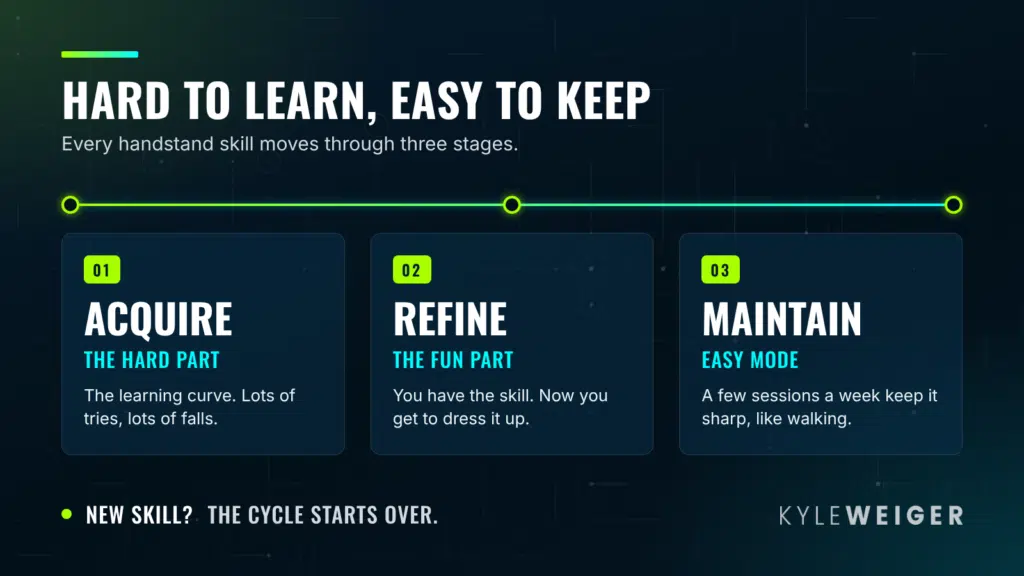
And then, once you pick a new skill, the whole thing starts over.
Say you go from a two-arm handstand to a one-arm handstand. You’re back at the bottom of a learning curve. You’ll get it for a couple of seconds and fall, and that will happen for a long time. Then you’ll refine it. Before you know it, your one arm is on maintenance mode too. Then you pick a harder skill, and a harder one after that.
That cycle has a name. It’s called training. (It’s also why your handstand goals now will be your warm-up later.)
There’s no magic drill
People want the moment. They want the magic drill. They want one weekend workshop to fix every mechanical problem in their handstand.
That’s not how it goes. And trust me, I teach weekend workshops all over the world. That isn’t what they’re for. A workshop’s job is to teach you how to train, so you can take the thing that was once hard and put it on easy mode yourself.
Climb the curve
So if your handstand feels hard right now, good. That means you’re in the acquire stage, the hardest part of the whole journey. Every great handstander you’ve ever watched went through it, the same way you went through learning to walk.
Keep giving it reps. Keep showing up a few times a week. The curve flattens, and then you get to keep what you built.
If you want a clear path through that learning curve, The 4 Essential Handstand Elements gives you a 28-day plan built around Movement, Shape, Strength and Balance. The 28 days are a structure, not a deadline, so you always know what today’s session is.
Keep building with me
If this helped, come train with me on social. I share drills, form checks and coaching breakdowns for adult handstanders at every stage of the roadmap.
- Instagram: @kyleweiger
- TikTok: @handstandcoach
- YouTube: youtube.com/kyleweiger
- Facebook: Kyle Weiger Handstand Coach
You learned to walk once. You can learn this too, my friends.
Structure beats struggle.