Kyle Weiger
Share This
Can you handstand every day?
Can you do a handstand every day? Sure, if you want to burn out quickly.
Smart handstanders stagger their practice, and they take their rest days very seriously. In fact, the honest answer to “can you handstand every day?” isn’t a simple yes or no.
Here’s the short version: if you’re new, training every day shouldn’t be the goal. Instead, aim for a few solid sessions a week while you develop your capacity, and figure out a pace that works for you.
Doing a handstand every day vs training every day
There’s a big difference between doing a handstand every day and training handstand every day.
If you just kick up a couple of times, you can literally do that every day. That’s fine. I know people who go upside down for a few kick-ins each day, and that’s how they get their frequency. But how much volume, training and skill are you actually getting from those reps?
A real training session is different. If you’re putting in 45 minutes to an hour and a half, you don’t want to do that every single day, especially if you’re new.
Why your rest days matter
I approach handstands the same way I approach lifting. I don’t lift every day, and I definitely don’t max out every day. That’s because I want to keep training for the long term.
When you put a big amount of effort into bearing weight on your hands, your body needs rest. That rest is when your body adapts, so you can bounce back stronger and better in your next practice.
In other words, rest days are part of your structure. They give your body the chance to recover and adapt to everything you’ve been learning and training.
What 15 years of handstands taught me
I’ve been training handstands for 15 years and coaching for the last 10. For the last 5, I’ve been training very seriously, to the point that I moved to Las Vegas just to train with the coaches here.
And I can tell you this: every one of them, myself included, will tell you to take your rest days.
When can you train more often?
Experienced handstanders can train more frequently. However, that’s because they’ve built the capacity to do it over long periods of time, and their wrists can handle the load.
So more frequency isn’t off the table. It’s something you build toward, not something you start with.
How my courses build rest into your week
In my courses, training sessions run about 45 to 60 minutes, and rest days are built right into the program. For example, here’s the 28-day schedule from The 4 Essential Handstand Elements. It runs four phases of seven days each, with rest days built in, and you aim for at least three sessions a week.
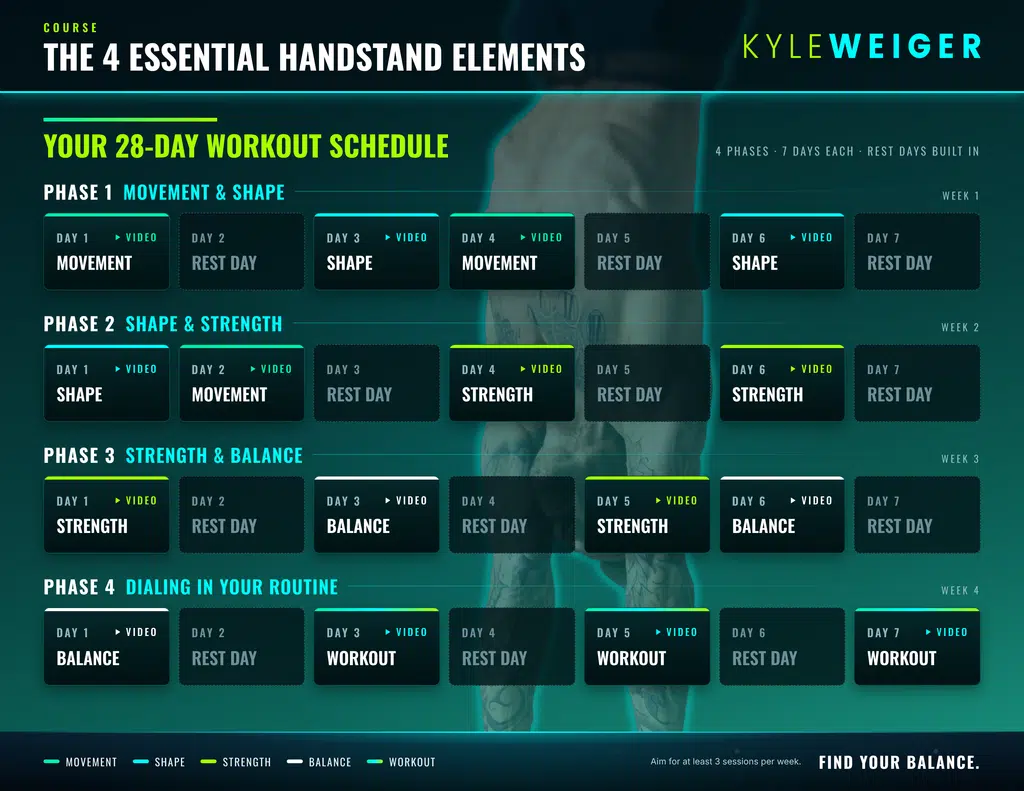
Try this in your next week
- Pick three training days. Plan a 45 to 60 minute session for each one.
- Put rest days in between. Schedule them on purpose, just like your training days.
- Treat rest as real rest. Let your wrists and shoulders recover, so your next session counts.
Then, as your capacity grows over months and years, you can slowly add more.
Get a schedule with rest built in
If you’d rather not build your own schedule, The 4 Essential Handstand Elements does it for you. Every phase is mapped out, with rest days built in, so you always know when to train and when to recover. I designed it for adult beginners working at the wall who want a clear path forward.
Keep building with me
If this helped, come train with me on social. I share drills, form checks and coaching breakdowns for adult handstanders at every stage of the roadmap.
- Instagram: @kyleweiger
- TikTok: @handstandcoach
- YouTube: youtube.com/kyleweiger
- Facebook: Kyle Weiger Handstand Coach
Train smart, rest on purpose, and play the long game. You’re on the right path, my friends.
Structure beats struggle.